
A succession of storms blew through our slice of paradise late Saturday afternoon and again early Sunday morning, with the final torrent knocking out our power. The English major in me leans into metaphor more often than I should, I suppose, but in some respects the tumult followed by a blackout was a bit like the rise and fall of Elvis Presley, the first and last king of rock ’n’ roll. He blew through mid-1950s pop culture with a hurricane-like gale until 1958, when Uncle Sam inducted him into the Army.
Most music fans know the broad outline of his story, including his post-G.I. abdication, Hollywood exile and late-1960s reclamation, which featured a TV special, taut studio album in From Elvis in Memphis, and several singles that added gravitas to his persona.
The “Vegas Years,” as they’re often called, began on July 31, 1969, when Elvis headlined the International Hotel’s 2000-seat showroom. Over the next seven years, he played 15 multi-night runs—636 shows in total—with each engagement running about a month until his final stints, which were about two weeks each. The initial residencies in ’69 and ’70 found him at the top of his game, as evidenced by the Live 1969 and That’s the Way It Is box sets. Those ’70 shows, however, introduced the garish symbol of his decline: the jumpsuit.
The Merriam-Webster dictionary defines kitsch as “something that appeals to popular or lowbrow taste and is often of poor quality.” A secondary explanation is “a tacky or lowbrow quality or condition.” They could well have included a picture of the jumpsuit-clad Presley from the mid-1970s and left it at that.
That’s a lengthy preamble, I know, for this review of The Rise and Fall of American Kitsch. The seventh album from Americana-flavored singer-songwriter Karen Jonas, it takes inspiration from Elvis, the plastic pink flamingos of the 1950s, and useless knickknacks that line our shelves. Recorded live in the studio, it features Tim Bray on guitar, Ahren Buchheister on pedal steel, Bobby Hawk on fiddle, Seth Morrissey on bass, Benji Porecki on keyboards, and Ben Tufts on drums. It’s a terrific album.
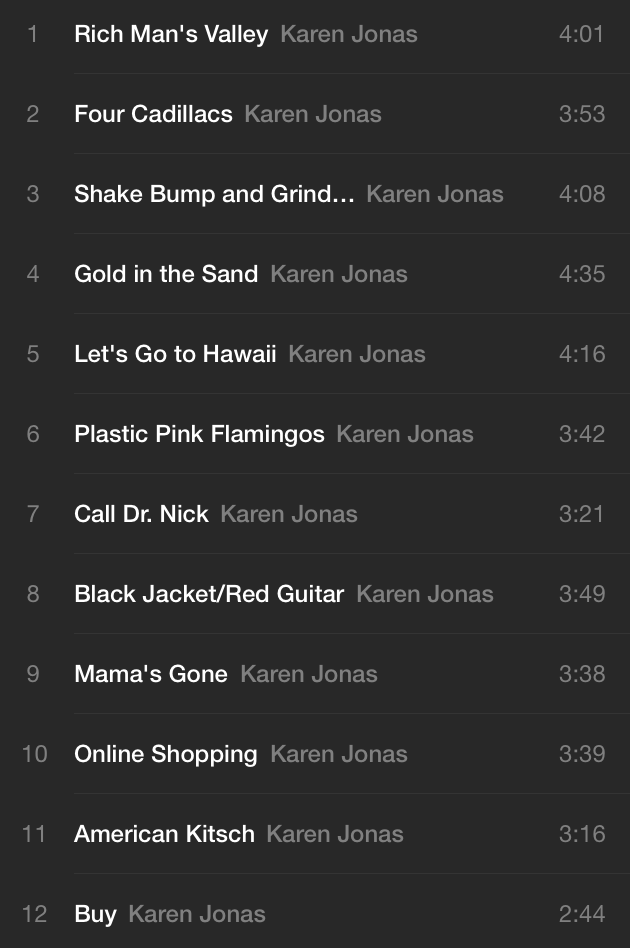
It opens with “Rich Man’s Valley,” about how the Carter Family overcame impoverished roots and, along with Jimmie Rodgers, built the foundation and framework for country music. It’s a rip-roaring tune, as is the one that follows: “Four Cadillacs,” which takes inspiration from the lavish spending sprees Elvis was famous for.
“Shake Bump and Grind Show” slows things down while excoriating the outrage that erupted when “Elvis the Pelvis,” as his detractors called him, performed during the mid-1950s. “Gold in the Sand,” meanwhile, explores the mirage that is Las Vegas. “It’s mostly a losing town,” she notes, puncturing the neon promises promoted by casinos. “Let’s Go to Hawaii,” on the other hand, is a Jimmy Buffett-like tune about a woman pushing her spouse to splurge on a second honeymoon in hopes that hula dancers, drinks and her bikini will re-spark something in them: “We’ll lie on the beaches beneath the moon beams and yes/we’ll fall in love again/we’ll sway in the breezes beneath the palm trees and yes/we’ll fall in love again.”
“Plastic Pink Flamingos” pays tribute to the kitsch lawn decoration in humorous fashion: “Somewhere in a factory uptown/they churn out pink flamingos til the sun goes town/just like God created the great cosmos/but instead they’re making plastic pink flamingos.” The fun is flipped with “Calling Dr. Nick,” however, with Jonas exploring how Elvis Presley’s personal physician, Dr. George Nichopoulos, doled out medication as if he was a drug dealer.
The taut “Black Jacket/Red Guitar,” sung from Priscilla’s perspective, digs into the myths and sad reality surrounding Presley: “You used to hold my gaze/now you watch the world watch every move we make.” “Mama’s Gone,” on the other hand, explores how the death of his mother devastated him. “Online Shopping,” for its part, is a humorous expose of the modern psyche and how we, like Elvis, distract ourselves from the craziness in the world by buying things, almost anything.
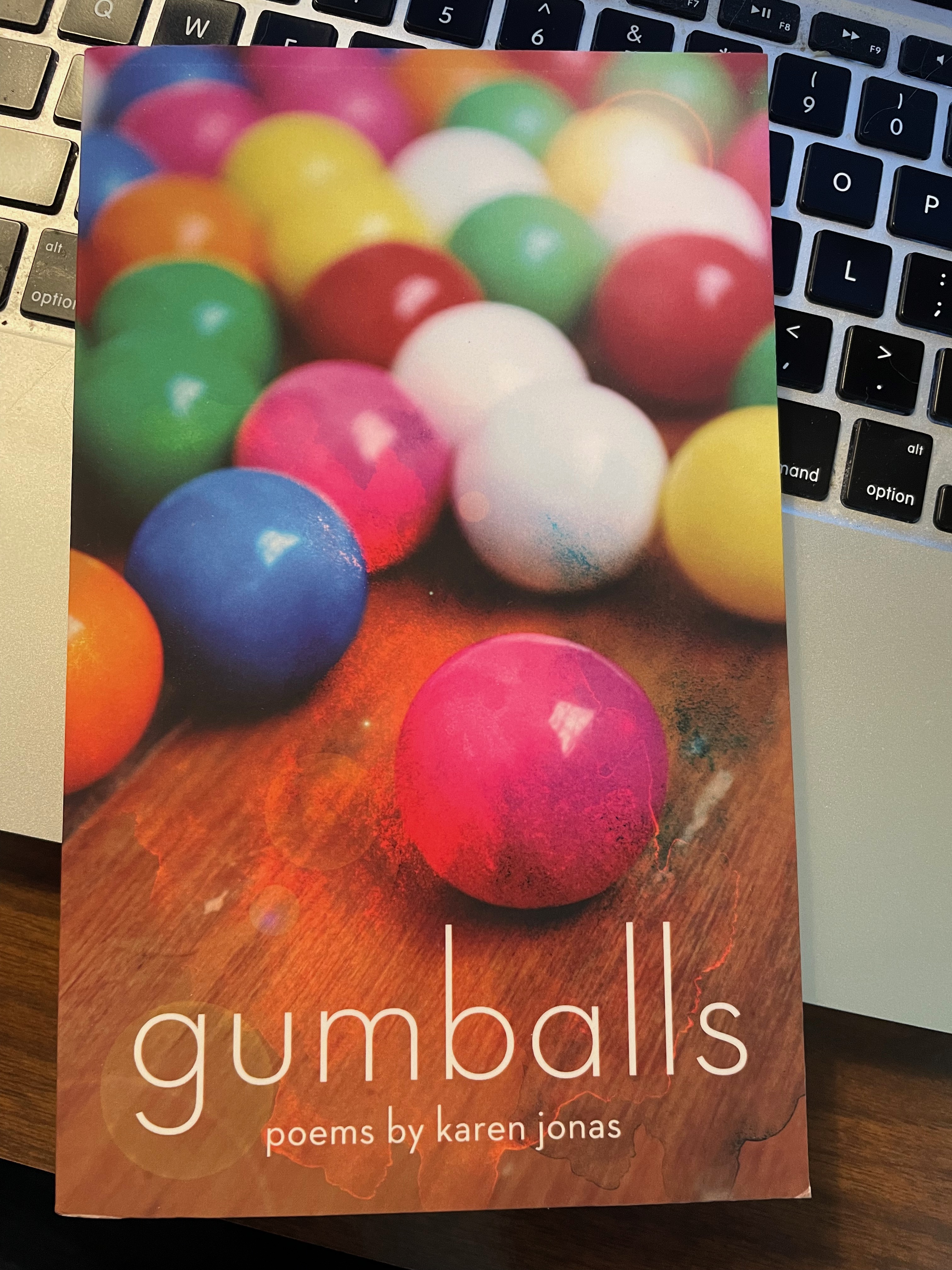
“American Kitsch” is a riveting spoken-word piece that explores how consumerism has essentially become our national religion. As evidenced by Gumballs, a collection of poems she released in 2021 (and that I heartily recommend), she possesses a distinct poetic voice that weaves large truths from small details. It’s on full display here. It’s my favorite track.
The album closes with “Buy,” which expounds upon “Online Shopping” and how spending is often fueled by the faux realities we see and read in movies, TV, books, magazines and social media. We distract ourselves from our seemingly sad-sack lives (which are usually anything but) by whipping out our wallets to buy things we don’t need and can’t afford. (Word to the wise: “Retail therapy,” as it’s called, doesn’t accrue anything but debt.)
I’ll end with this: The sad saga of Elvis Presley has become a cautionary tale, with his panther-like visage giving way to bloated garishness. (He capsized in excess, if you know what I mean.) In the years since his death, he’s become a metaphor for an American dream run amok. The Rise and Fall of American Kitsch speaks to all that and more with the precision of a poet’s eye. It’s not just, as I said above, a terrific album. It’s one of the year’s best.
(It can be purchased from Bandcamp.)
 The Old Grey Cat
6 thoughts