
I blame Karen Jonas for re-sparking my long-dormant fascination with Elvis Presley. Her Rise and Fall of American Kitsch—the best album of the year thus far, says I—explores America’s embrace of excessive consumerism via, in part, the prism of the first and only king of rock ’n’ roll. It primed me to, last weekend, watch the 1972 documentary Elvis on Tour for the first time in decades, and then press play on the Live 1969 box set, which collects his first spurt of Las Vegas concerts, and the Elvis on Tour box, which features four of the ’72 shows featured in the documentary alongside two discs of rehearsals.
The five-disc Memphis collection gathers 111 songs that were recorded in the Birthplace of Rock ’n’ Roll, with 88 of them remixed by hometown engineer-producer Matt Ross-Spang at his Southern Grooves studio. Ross-Spang, for those not familiar with him, made his bones at the legendary Sun Studio, where he rose from a 16-year-old intern to become chief engineer. Since 2015, when he set out on his own, he’s worked with producer Dave Cobb and such stalwarts as Jason Isbell, Margo Price and Lori McKenna, and nabbed several Grammy Awards.
The myths that surround Presley are legion even now, some 47 years after he passed, despite the highs and lows of his life being rehashed time and again in books and films, most recently Baz Lurhmann’s overly stylized Elvis. At the same time, compilation after compilation, box set after box set, have been released in the years since his death. Wikipedia, for instance, lists 115 posthumous collections and 30 box sets.
What to know about Memphis: Despite claims to the contrary, it’s not definitive. Though much of what he recorded at Sun, American Sound Studios and Stax in the 1950s, ‘60s and ‘70s is here, it’s not everything. I’m very familiar with his 1969 sessions with Chips Moman at American Sound Studios, for instance, and quite a few of those tracks are MIA, including “Inherit the Wind” and “Rubberneckin’.” Posts about the set at the Steve Hoffman forums list at least 13 missing songs. Strange, huh?
The Sun sessions, I’m sure, will cause the young to scratch their heads and wonder what the fuss was about. By today’s standards, the performances are tame—yet, without them, the rock ’n’ roll explosion wouldn’t have happened. They marry country to R&B in a way no one had before, and are accented by both wide-eyed innocence and excitement.
The main reason for the box, besides collecting the majority of his Memphis recordings together, seems to be the Moman-produced tracks, which are presented in a similar fashion to Paul McCartney’s recent “underdubbed” Band on the Run. Gone are the accoutrements (backing vocals, horns and strings) that were added after Elvis had left the building, in other words. The stripped-down approach doesn’t change the nature of the songs, of course, but are interesting. That said, when or if I have a hank-a-hank-a-hankering to listen to the American Sound Studio sessions in the future, I’ll turn to either From Elvis in Memphis, Back in Memphis or the one-CD 1987 Memphis Record collection.
Memphis also includes a March 20, 1974, concert at the Mid-South Coliseum, which was first released in truncated form that June as Elvis Recorded Live on Stage in Memphis and then in full on a 2004 re-release that, thankfully, stripped out the post-production applause that marred the original LP. Similar to the 1972 shows on the Elvis on Tour box, it’s a mix of the sublime and mundane, but with Presley’s boredom bubbling to the fore more often. Compared to the riveting sets gathered on the Live 1969 box, he’s a shadow of himself.
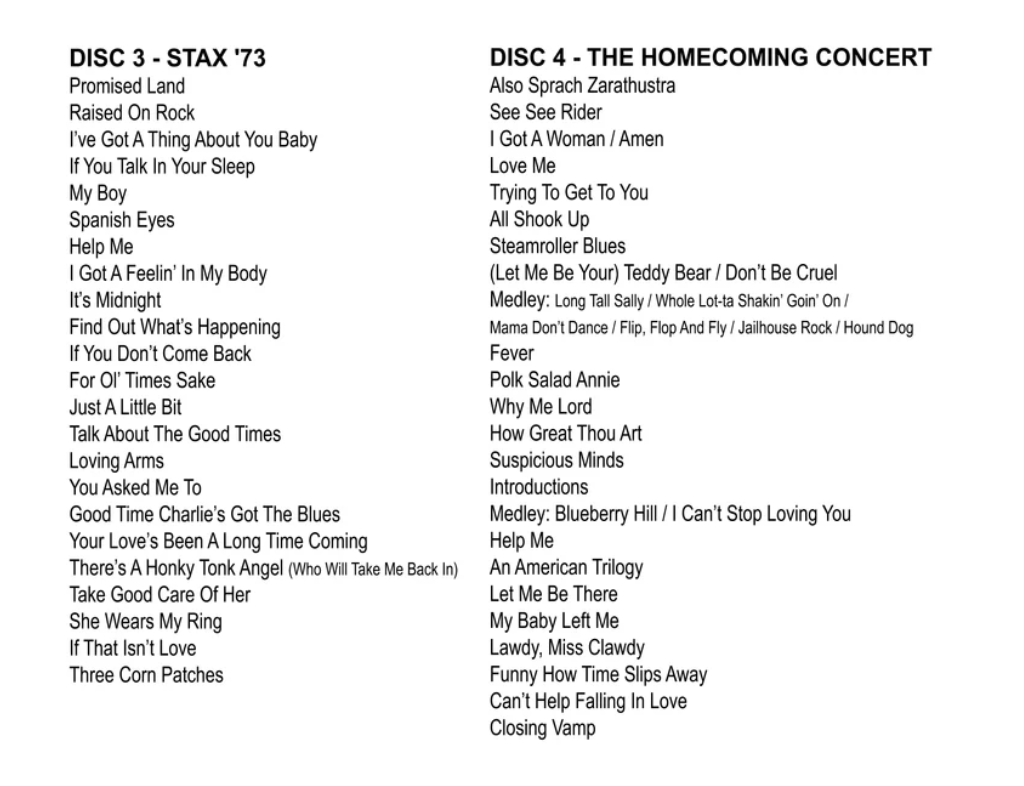
The 1973 Stax sessions, gathered on Disc 3, are hit and miss, veering from the taut “If You Don’t Come Back” to the perfunctory “For the Ol’ Times.” The same can be said of the so-called Jungle Room recordings of ’76, so named because Elvis couldn’t be bothered with heading to a studio to record. Instead, they brought the studio to him, setting up the gear in Graceland and waiting for him to show up. Some days, it’s said, he’d record a song only to wander off, not to be seen again for several hours. (I’d wager that his aversion to recording was related to the lack of solid songs he was being offered.) That said, “Moody Blue,” “Way Down” and “He’ll Have to Go” rival the best of his ‘70s output.
All that said, Memphis is a worthwhile listen. It charts the course of Presley’s career from his earliest days to his last, all through the prism of his adopted hometown. I don’t recommend buying it, however. Streaming will suffice.
The tracks:


 The Old Grey Cat
2 thoughts