
I am a sucker for the lounge music of long ago, when singers gave life to songs old and new alongside gems sometimes identified with them. At best, they became one with the music; at worst, they entertained. Where I hear magic, however, others occasionally don’t. Earlier this year, for instance, we had a houseguest who voiced her disdain when, while we watched a Best of the Ed Sullivan Show episode on PlutoTV, a “supper club” singer performed what I heard as a transcendent rendition of a mid-1960s hit.
If you’re like that houseguest, this collection may not be for you.
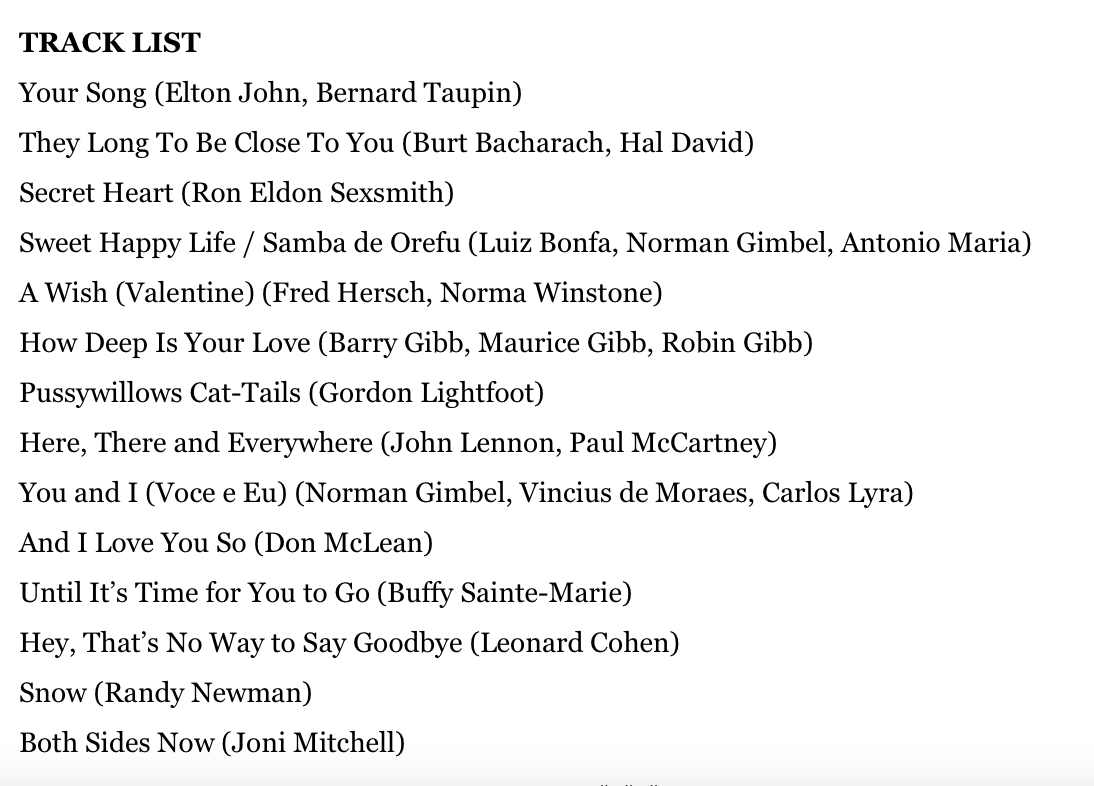
To my ears, however, Soft Winds and Roses—out this Friday, the 25th—is a stirring collection. Canadian jazz chanteuse (and two-time Juno Award winner) Diana Panton creates a series of intimate scenes throughout her 11th album, accompanied by Reg Schwager on guitar and Don Thompson on piano, vibes and bass. Some songs are well-known chestnuts of the 1960s and ‘70s, others lesser-known but just as sweet. The stripped-down production emphasizes Panton’s vocals; it sounds as if she’s singing in your ear.
In the press release, she explains the album’s genesis: “Through the years, I have recorded several compilations for the Asian market, and I was often asked to include a bonus track that was a bit more contemporary and well-known in that market than some of my more obscure song choices. Fast forward to the present: I decided to assemble a selection of modern standards composed from the 1960s onward.”
“(They Long to Be) Close to You,” released as a single a few weeks back, is one highlight. Although associated with the Carpenters due to their 1970 hit, the Burt Bacharach-Hal David tune has a long history that includes wonderful versions by Dionne Warwick (1964) and Dusty Springfield (1967), plus—pushing ahead several decades—Rumer’s rendition on her 2016 Bacharach tribute album. Panton’s version, like Rumer’s, allows the lyrics to breathe; it’s magic pressed to wax, just about.
The same is true for her cover of the Bee Gees’ “How Deep Is You Love,” which shimmers like the sun on a summer’s day. Her effervescent rendition of “Sweet Happy Life,” which began life in 1959 as “Samba de Orfeu,” is another delight; it wafts from the horizon like cotton candy clouds, if that makes sense. I wasn’t familiar with Gordon Lightfoot’s “Pussywillows Cat-Tails” prior, but wow. It’s beautiful, too—as is the album as a whole. And did I mention “Here, There and Everywhere” and “Both Sides Now”? The first is beautiful, the latter profound.
 The Old Grey Cat