


Politics is the easy answer here—but while the tinpot despot and his toadies are tempting targets, as their cruelty and ignorance knows no ends, the truth is my main complaints of late have to do with the way artificial intelligence is being bandied about. For the past month-plus, an album out this Friday—GHOST from Asa Horvitz, Carmen Quill, Ariadne Randall and Wayne Horvitz—found me debating myself over its use of AI to compose the lyrics for what is, and I don’t say this lightly, a mesmerizing piece about grief. (I plan to spotlight it tomorrow, for those curious.)
Artificial intelligence has been at the heart of much hype and fear due to Big Tech’s lunkheaded attempts to shoehorn it into every facet of life. The goal is to replicate HAL 9000 from 2001: A Space Odyssey—and, too, increase profits by swapping white-collar workforces for the synthesized kind. CEOs and shareholders salivate at the thought of lowering costs; that computer code will never fully replicate imagination doesn’t much matter—their wallets are getting fatter, after all. (It’s the same rationale they used to ship factory jobs overseas.) The first workers to go, and we’re witnessing it in real time as I write, are the ones corporations and their paid-for politicians dislike the most: journalists, writers, artists of all types. (I.e. the ones who hold them to account.)

One of the things that I like to do, in between tap-tap-tapping on the keyboard, is to leaf through poetry tomes. Some of the poems are concise, others verbose, but either/or they delve into what it means to be human. And most, though certainly not all, have been absorbed into the current crop of AI tools, which lean on large language models that “allow them to understand, generate, and translate human language.” That last bit is a direct quote from Google’s AI tool, Gemini.
So, too, is this: “At the heart of Gemini are neural networks. These are complex computational systems inspired by the structure of the human brain. They consist of layers of interconnected nodes (or neurons) that process information. Specifically, LLMs often utilize a type of neural network architecture called a transformer.”
Out of curiosity, I asked whether it incorporated poetry in its LLM. It responded:
- Vast Training Data: Gemini was trained on a massive dataset of text and code, which undoubtedly includes a vast collection of poems, both classic and contemporary. This exposure allows it to learn the patterns, styles, and forms of poetry.
- Generating New Poems: Gemini can generate poems in various styles, mimicking the structure and language it has learned. It can even incorporate specific themes, forms, or even the style of a particular poet if you prompt it to.
- Not a “Poet” in the Human Sense: It’s crucial to remember that Gemini doesn’t “understand” poetry in the way a human does. It doesn’t have emotions, experiences, or personal interpretations to draw upon. Instead, it’s incredibly skilled at recognizing patterns and generating text that fits those patterns.
The same is true when it comes to songs: “Yes, Gemini can definitely write songs! It has learned the structure, patterns, and language of music from its massive training dataset, which includes a vast collection of songs across genres and eras.” It’s easy to foresee a day when the bulk of all mainstream “creative” works, be they movies, novels or songs, are the result of an executive’s input into an AI prompt, in other words. It’s just as easy, however, to foresee the day when most of us reject such soulless endeavors.
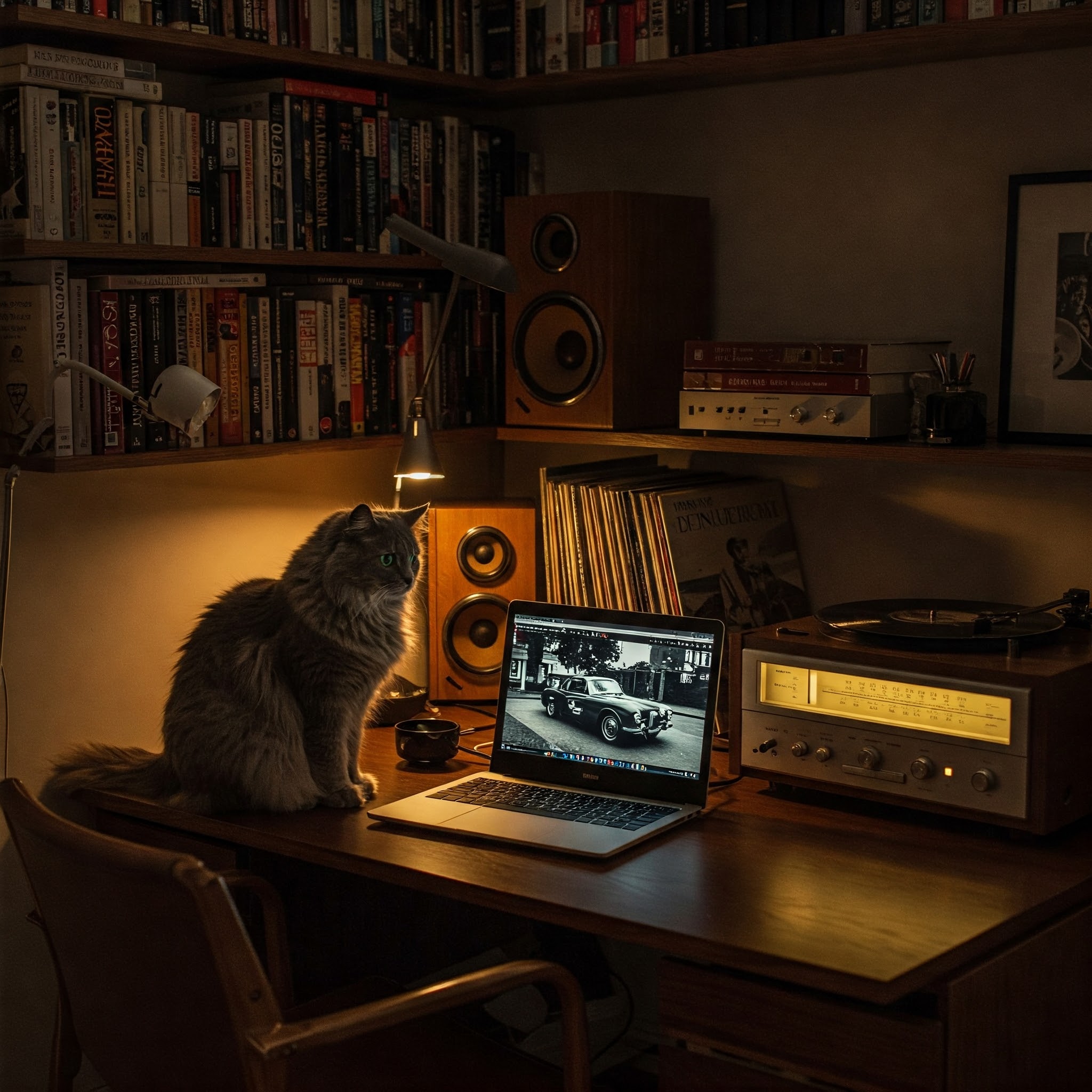
I’ve used the term “mimeographed marvels” from time to time to describe music, often by our favorites, that conjures but doesn’t capture the magic of past works. But when there are no favorites to replicate, what then?
As I see it, AI is essentially a shovel that can be wielded for good (removing snow from a sidewalk) or bad (hitting a neighbor over the head). I’ve used both Google Gemini and Meta’s version to create many of the cat-themed images that litter my “Daily Prompt” posts, for example. I find them fun to play with, much as I once enjoyed playing with Bryce 3D, Poser and Paint Shop Pro (I created many a cover for CD mixes with those). But I’d never try to pass them off as anything but what they are. Paint-by-numbers art can never convey the same emotion as, say, a painting by Luana Asiata. It just can’t. (If I ever hit the lottery, I plan to buy one of her works. Just sayin’.)
At present, unfortunately, AI is primarily being used to concuss us into submission—so it’s up to us to grab the handle and toss it aside. In some respects, now that I’ve thought it through, that’s what GHOST—the album I referenced above—does. It’s a path forward.
 The Old Grey Cat
One thought