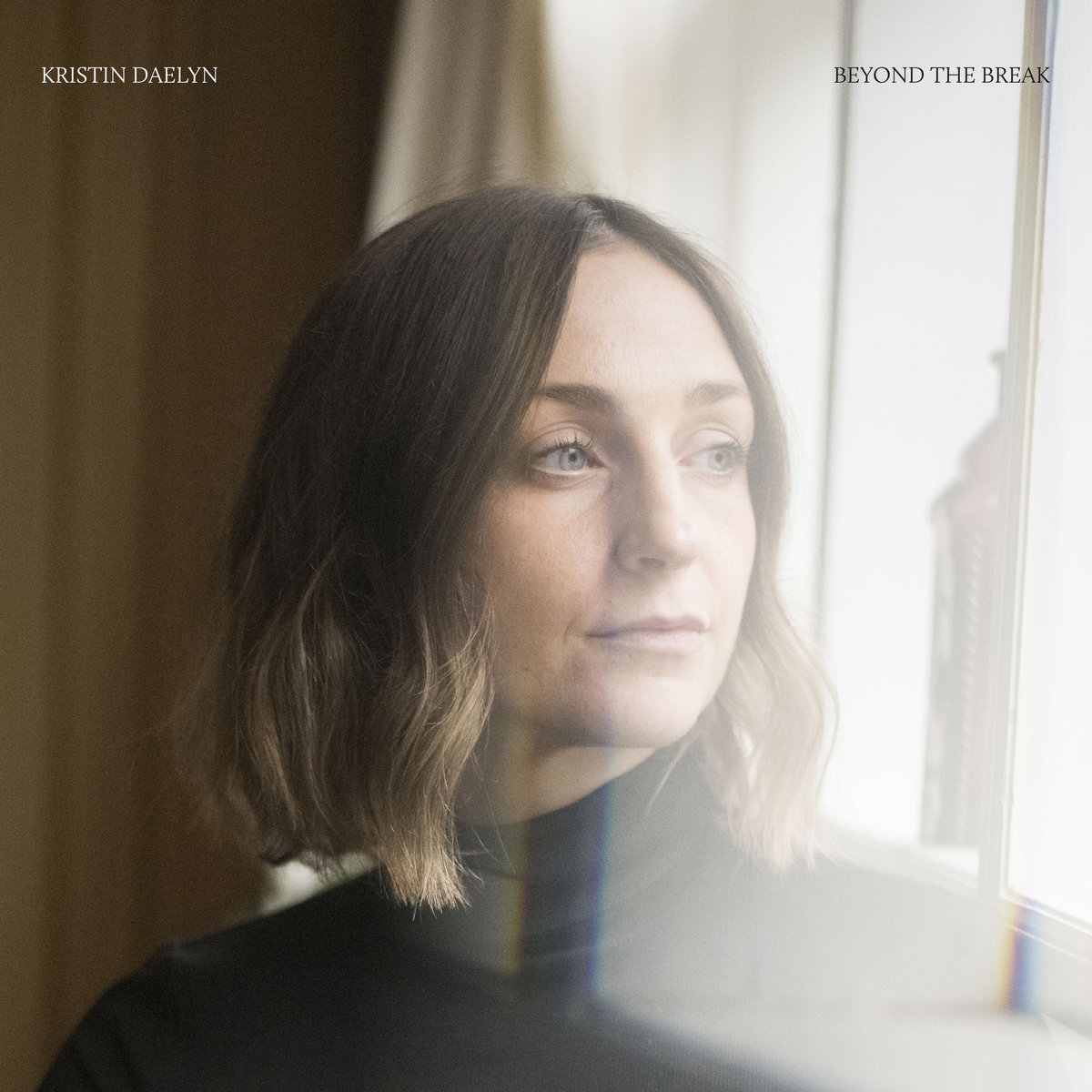
Philadelphia-based folk artist Kristin Daelyn’s Beyond the Break pushes through the environs we call the soul like a quiet but compelling storm. Accented by her deft fingerstyle guitar play, the eight-track set collects stirring instrumentals and contemplative songs, the kind that—in another era—would have oscillated through the late-night airwaves of progressive rock radio alongside works from Jackson Browne, John Fahey and Joni Mitchell.
Joining her are Adeline Hotel’s Dan Knishkowy and Good Old War’s Danny Black, plus classical player Patrick Riley, whose string arrangements on four tracks find him playing cello, viola and violin (though not all at once). “Quiet-Riter” opens the album on a sublime note before “Patience Comes to the Bones” widens the sonic stream to include Daelyn’s immersive voice.
I hear her lyrics, which were informed by a line in the Mary Oliver poem “Patience,” as a chronicle of grief—whether from a loved one’s passing or the death of a relationship, it doesn’t much matter. We process such ends in similar ways, with numbness from sorrow giving way to tomorrows drenched with memories of the long ago. Little things remind us of who and what we’ve lost, while big things toss us about as if we’re drifting across the tumultuous sea in a dinghy. In time, of course, acceptance sets in, the pain lessens, and we find ourselves on dry land, ready to move on.
“Longing,” for its part, echoes Jackson Browne’s “These Days” in form, while its substance tackles the yearnings that drive us. The press release quotes her as saying, “I started thinking about our relationship with longing. The further the distance between ourselves and the thing that we want, the greater the tension.” “Wanted” examines the same sensation from the other side, exploring how love sometimes recedes like the tide at night but, instead of pushing to shore in the morning, somehow eludes the gravitational pull of the moon. “An Opening” continues with the contemplative mood, while the instrumental title track peers into great beyond. “White Lilies,” for its part, finds her coming to terms with her new reality.
The album concludes with the moment of clarity that is “It Came to Me Then”: “Oh like a dream/It came to me then/How we will live/And live again/Veiled in summer’s hum/A blue but sweeter song/With river in my palms/I drink and know what its like to be loved.” As with the songs that came before, it’s a poetic observation about life’s many passages, about how ends give way to beginnings and beginnings, in time, ends. We look back and marvel and, at times, tear up, taking comfort where we can. It reminds me of the conclusion of Denise Levertov’s “Libation”:
We smile,
After these months of pain we begin
to admit our new lives have begun.
 The Old Grey Cat
2 thoughts