
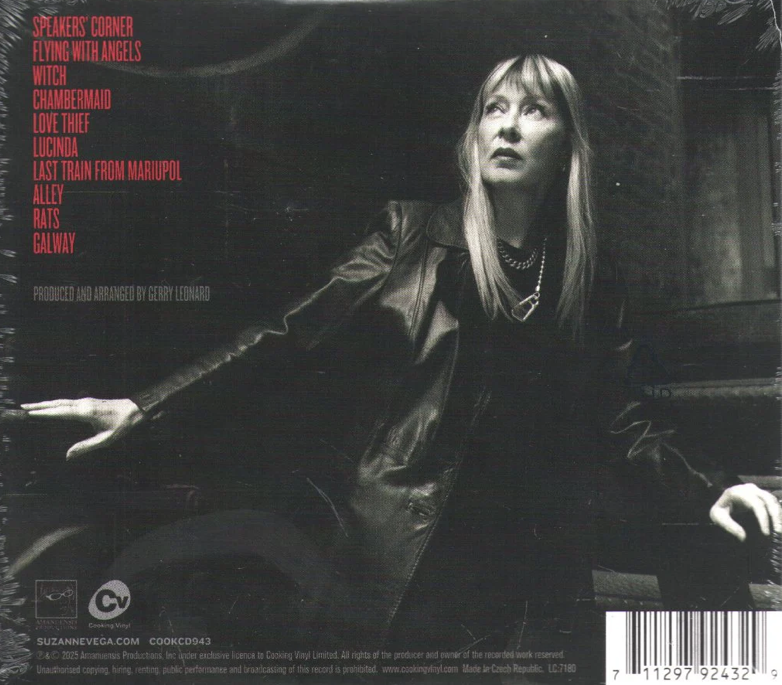
I am driving down the roadway on a Monday afternoon. I am headed to the post office and then to the butcher’s, and conscious of a speed limit that dips from fast to slow. I observe a stalled SUV being pushed by two men through a left turn at an intersection just as the light turns to red; honks from other vehicles unsurprisingly ensue. I don’t mind. I am playing Suzanne Vega’s new album: Songs of angels, witches, chambermaids and thieves pop from the speakers, the snappy wordplay in lockstep with succinct rhythms and melodies that never linger. Extraneous beats don’t exist within the construct of the compositions, but a borrowed tune (intentionally) does. Some tracks conjure olden times, however one wishes to define them, others echo the present.
Dub this collection, her first set of new songs since 2014, Suzanne Vega’s Dreams Nos. 1 through 10. Some songs are solely written by her, while others are collaborations with longtime consigliere/guitarist Gerry Leonard, who also produced.
“Speakers’ Corner” celebrates those who dare speak their mind in the public square, even when what they say makes little or no sense—or, worse, is little more than a grab for cash. In today’s world, of course, the speakers’ corner is essentially social media…and music. “I guess we better use it now/before we find it gone,” she sings. The atmospheric title track harkens back to the moody Solitude Standing, while the tense “Witch” reminds me of 99.9 F° and includes a couplet that seems applicable to the present political climate: “We’re living in a state of a permanent emergency/Suddenly speech is a show of absurdity.”
“Chambermaid” borrows its melody from Bob Dylan’s “I Want You” while expanding upon and flipping that song’s “chambermaid” stanza (“Well, I return to the Queen of Spades/And talk with my chambermaid…”), showing us life through her eyes: “I’m the great man’s chambermaid/I’ve seen where his hallowed head is laid/I revere the places he has stayed/And clean crumbs from his typewriter/He is good to me/There’s nothing he doesn’t see/He knows where I’d like to be/But it doesn’t matter.”
In another era, aka the mid-1970s, “Love Thief” would be paired on the radio with any of many Barry White songs; it’s a sultry R&B jam about love in the grandest sense of the word: “I am the love thief/And I’m coming for you…/I don’t mean sex/Or even money/Sugar, thyme or honey, no/I mean your heart/And your consciеnce too/To these things bе true/Tell me, how can you lose?” “Lucinda,” which follows, is a chugging tribute to Lucinda Williams that captures the alt.country singer-songwriter’s visage, grit and guts, yet ultimately misses the mark. My long-ago poetry professor often scrawled a simple statement at the bottom of the page of an overly descriptive piece: “Don’t state, create!” There are many cool singer-songwriters in this world, after all. Why sing about Lucinda? Does the music take her there, wherever there is?
“Last Train from Mariupol” more than makes up for those (minor) quibbles, with Vega—at her minimalistic best—exploring the human consequences of war. “Alley,” for its part, is a moody gem that finds her daydreaming about her demise. “Rats” revisits the sonic template of 99.9 F° while unreeling humorous lyrics about the rodents that thrive in New York City. The album closes with the touching “Galway,” essentially a short story set to song; it would’ve been at home on her long-ago debut.
Truth be told, I have not been as faithful a Suzanne Vega fan as I could have been through the decades, veering off for a spell after Nine Objects of Desire, but still consider Vega one of the most important artists of her—and my—time. Flying with Angels confirms it. Her voice sounds as strong as ever, while her poetic observations on life, love and war resonant with her best works. (The LP, though delayed, is available for purchase via her website.)
 The Old Grey Cat
5 thoughts