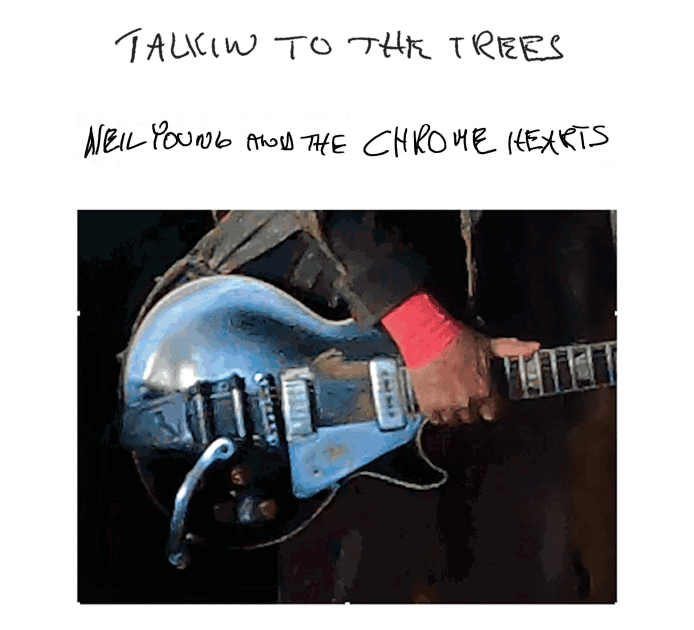
Neil Young’s Talkin’ to the Trees finds the aging godfather of grunge backed by an ensemble he’s dubbed the Chrome Hearts—Micah Nelson (guitar), Corey McCormick (bass) and Anthony LoGerfo (drums), all of whom toured and recorded with him as part of the Promise of the Real, and legendary Muscle Shoals Rhythm Section member Spooner Oldham (organ), who’s played with him off and on since Comes a Time in 1978. The 10-track set, co-produced by impresario Lou Adler, is rife with recycled riffs and borrowed tunes, including a few of his own. It’s not his best—but it’s not his worst, either. Rather, like much of his latter-day work, it falls somewhere in the vast in-between.
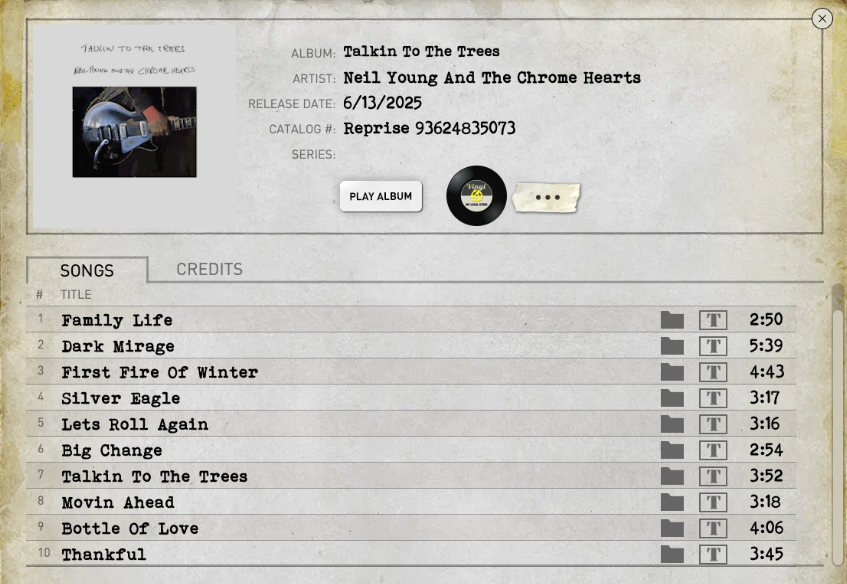
The album opens with “Family Life,” a folk-flavored shuffle about hearth, home…and not seeing his grandkids due to discord between him and his daughter. “Dark Mirage” dollops out the greasy blues while delving further into the estrangement, with his barbed lyrics far from an olive branch: “Well, I lost my little girl/To the darkness inside/Her mama’s gone now/And there’s nowhere to hide.” It’s a sad moment when a parent, no matter the reason, calls out their child—but to do so in a song is even worse. (To place a line from Stephen Stills in a different context, “Nobody’s right if everybody’s wrong.”)
“First Fire of Winter” is a more prototypical Neil number, given that it echoes the wistful feel of “Helpless,” while the lyrics focus on love, nature, and a lion that lurks in the trees. “Silver Eagle,” which borrows its melody from “This Land Is Your Land” (which itself was based on the Carter Family’s “When the World’s on Fire,” with that melody—although credited to A.P. Carter—likely procured from elsewhere) moseys down memory lane via his touring bus. It’s followed by “Lets Roll Again,” which speeds up the same melody while advising American auto companies to build better cars.
He and the band crank it up for “Big Change,” a loud and angry song that features guitars welling up like waves that never break. To my ears and taste, it and the title track are the highlights of the album. “Talkin’ to the Trees” references Dylan, the songs he was singing, and his own “Prime of Life,” all while surveying his current life and contemplating whether time has passed him by; it’s a sentiment many of us share, I think.
The rhythmic “Movin’ Ahead,” on the other hand, is a perfunctory jam about looking forward, not back; it’s white bread, not Toast. The jazzy “Bottle of Love,” however, is a low-key gem. The gentle “Thankful,” which reminds me somewhat of “Harvest Moon,” concludes the album on a contemplative note: “I’ve been pilin’ on the years/Full of laughter, sometimes tears/I feel thankful for them now/Want to keep them here with me somehow.”
In short, Talkin’ to the Trees is an inconsistent outing. Moments of grandeur share space with songs that fail to resonate longer than their length—par for the course, as I indicated up top, for Neil’s latter-day albums. That said, those moments of grandeur are reason enough to press play. “First Fire of Winter,” “Silver Eagle,” “Big Change,” the title track, “Bottle of Love” and “Thankful” would have made for a great EP.
(It’s available for purchase and to stream of course, including from the Neil Young Archives.)
 The Old Grey Cat