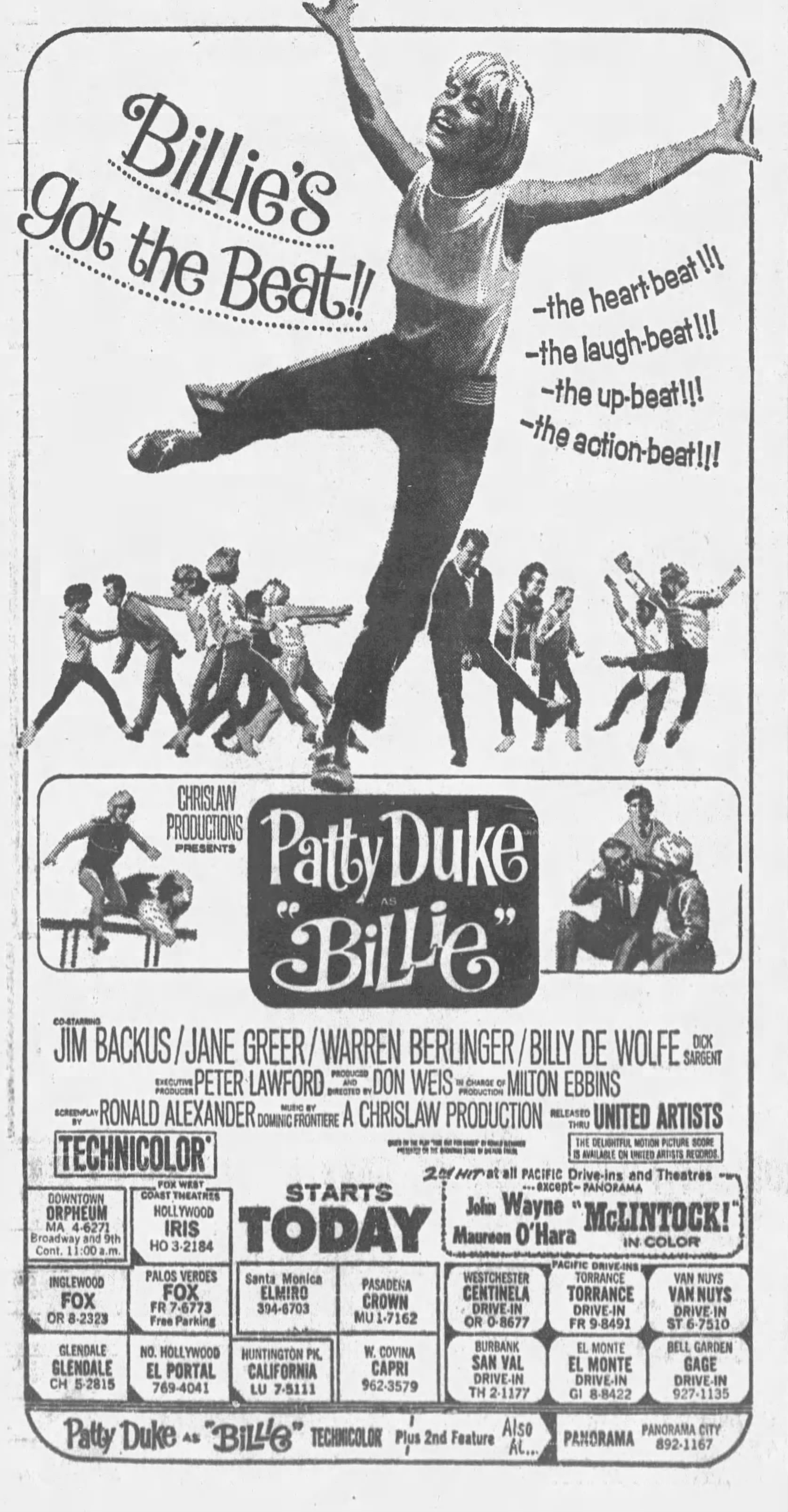
Yesterday, we clicked play on two movies that offered windows into life long ago. Old Acquaintance, a drama from 1943, stars Bette Davis and Miriam Hopkins as old friends and authors—one writes literature, the other pens trash. It starts strong, but at a certain juncture leaps into the abyss of unintended silliness. (Fun fact: It was remade as the sudsy 1981 film Rich and Famous, with Jacqueline Bisset and Candice Bergen assuming the roles of the writers.) The second movie, a family-friendly Patty Duke comedy from 1965 titled Billie, was just plain dumb from start to finish—and, perhaps because of that, a lot more fun.
The plot: 15-year-old “tomboy” Billie Carol finds herself the star of her school’s all-boy track team due to the innate rhythm that percolates through her head. Those were the pre-Title IX days, by the way, when many high schools didn’t offer robust programs for girls, so her pole vault into the world of male sports causes an uproar. It not only lands her on the cover of Life magazine, but threatens to derail her nascent romance with a fellow track athlete (Warren Berlinger, who looks like he’s pushing 30)—and, worse, upend the mayoral campaign of her gasbag dad (Jim Backus)!
Wait, what?! Who!? Yeah, yeah, I should have mentioned the supporting cast. Thurston Howell III takes up a fair bit of screen time, while Jane Greer—who starred with Robert Mitchum in the classic 1947 film noir Out of the Past—is underutilized as Billie’s demure mom. TV mainstays Charles Lane, Dick Sargent, Richard Deacon, Ted Bessell, and Susan Seaforth Hayes pop up in supporting roles, too, giving the movie the feel of a sitcom; the only thing missing is a laugh track. Lane plays to type as the cranky coach who sees in Billie the potential for greatness. Seaforth Hayes, meanwhile, glides onto screen as glamorous older sister Jean, who returns from college harboring a secret.
Directed by Don Weiss from a screenplay by Ronald Alexander, who adapted it from his successful Broadway play Time Out for Ginger, the film—like so many back in the day—plays it both ways, girded at first by nascent feminist leanings until it embraces the status quo with a predictable and pat ending. It’s serious fluff, in a way. Several musical numbers—yes, Duke sings!—add little to the goings-on, but allowed it to be billed as a “musical comedy.” (As the Los Angeles Times’ Margaret Harford opined in her review, “The songs are undistinguished.” Understatement, that.) The dance numbers, on the other hand, are indeed a treat, with Duke holding her own when teaching the guys about her internal beat in one and Robert Banas—who danced as a Jet in West Side Story—leading the way in another.
A contemporaneous news report says that, in preparation for the role, Duke rigorously trained with Olympic decathlon champion Rafer Johnson—though an obvious double takes her place in long shots. Still, as in her eponymous TV series, she turns in a charming performance, while the film is entertaining despite its flaws.
 The Old Grey Cat