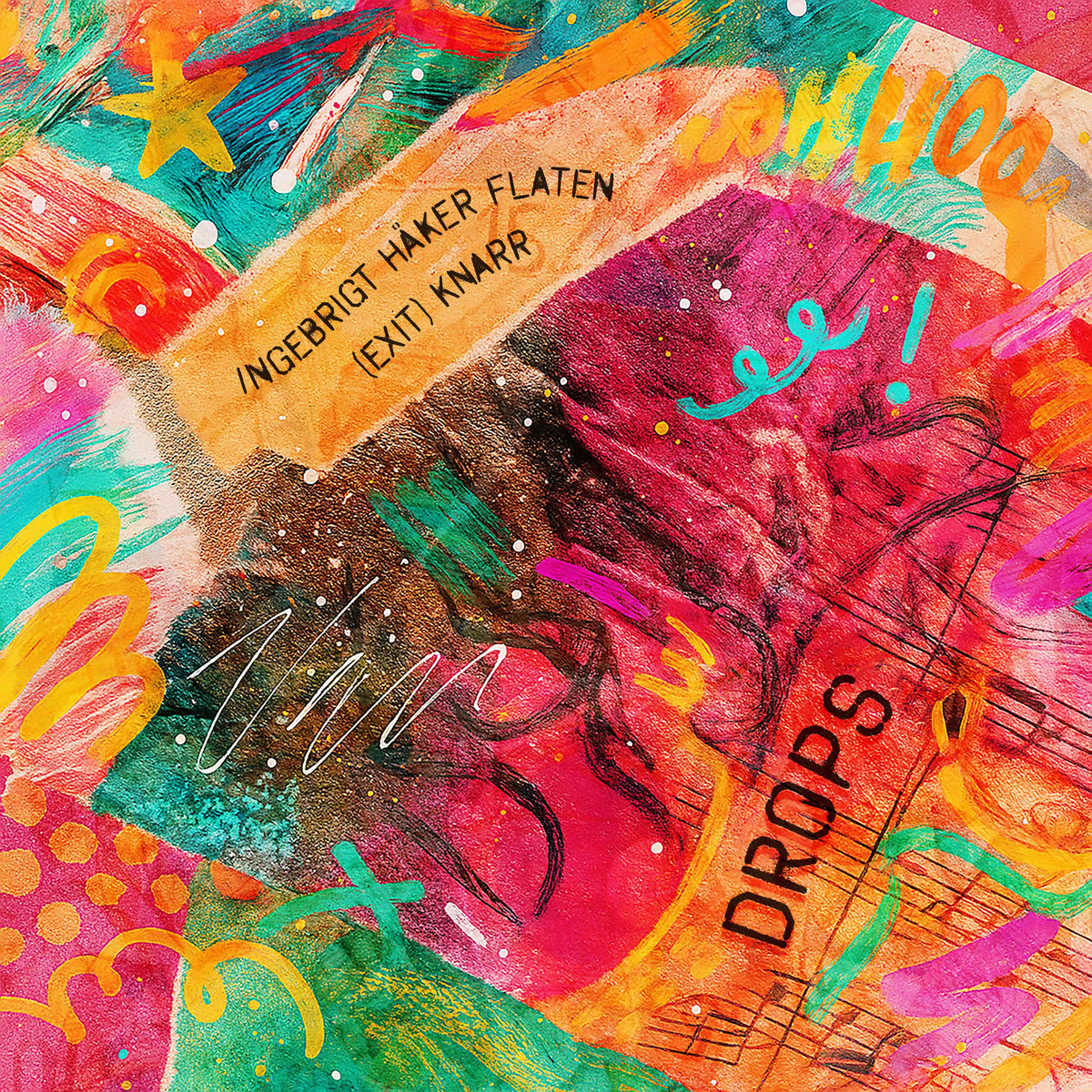
What began as a one-off project for the Vossa Jazz Festival in 2020 is now on its third studio outing. Drops finds the quintet, led by bassist-composer Ingebrigt Håker Flaten, delving deeper into the music via graphic scores, which swap out notes and staves for visual representations (shapes, lines, colors, symbols, and even images). “I used to love painting and drawing as a kid,” Håker Flaten explains in the press release. “Now, that re-connection to shape and color helps me communicate musical ideas to my bandmates more easily. It helps me share the core of my music without needing to explain it all in notes.”
Those bandmates include Amalie Dahl on alto sax, Jonathan F. Horn on guitar, Karl Hjalmar Nyberg on tenor sax and electronics, Marta Warelis on piano and electronics, and Olaf Olsen on drums; they’re a tour-seasoned ensemble. Recorded over two December days at Håvard Skaset at Børsen Kulturhus at Tangen in Norway, the album features three originals plus a rendition of Wayne Shorter’s “Deluge” (from his iconic 1965 JuJu album); “Deluge,” which was recorded live in the studio, fleshes out the sound even further by adding past band members Mette Rasmussen (alto) and Veslemøy Narvesen (drums) into the proceedings.
Some songs and albums are seemingly designed for the background. You press play and the melodies and rhythms disappear down the attention abyss, lingering out of the ear’s reach even when you have headphones on. The music becomes white noise, in a sense, blocking the outside world while you read, surf social media, or do such mundane stuff as fold the laundry. Drops, however, is the opposite. It forces itself to the forefront of the imagination, with a succession of discordant waves jelling into one before receding out to sea…and then starting again. Other activities fade away, in other words. You listen and, yes, lose yourself in the ebb and flow, the cacophony and the quiet.
Freeform/improvisational jazz isn’t for everyone, of course. Some hear it as a jumble of notes and chords in search of melody—which, in a sense, it is. The same’s true for beats. At least as I hear it, however, the whirlwind or whirlpool of sound and fury signifies something far more than the individual instruments. It’s a reflection of our oft-chaotic world, its jags and lows.
 The Old Grey Cat
One thought