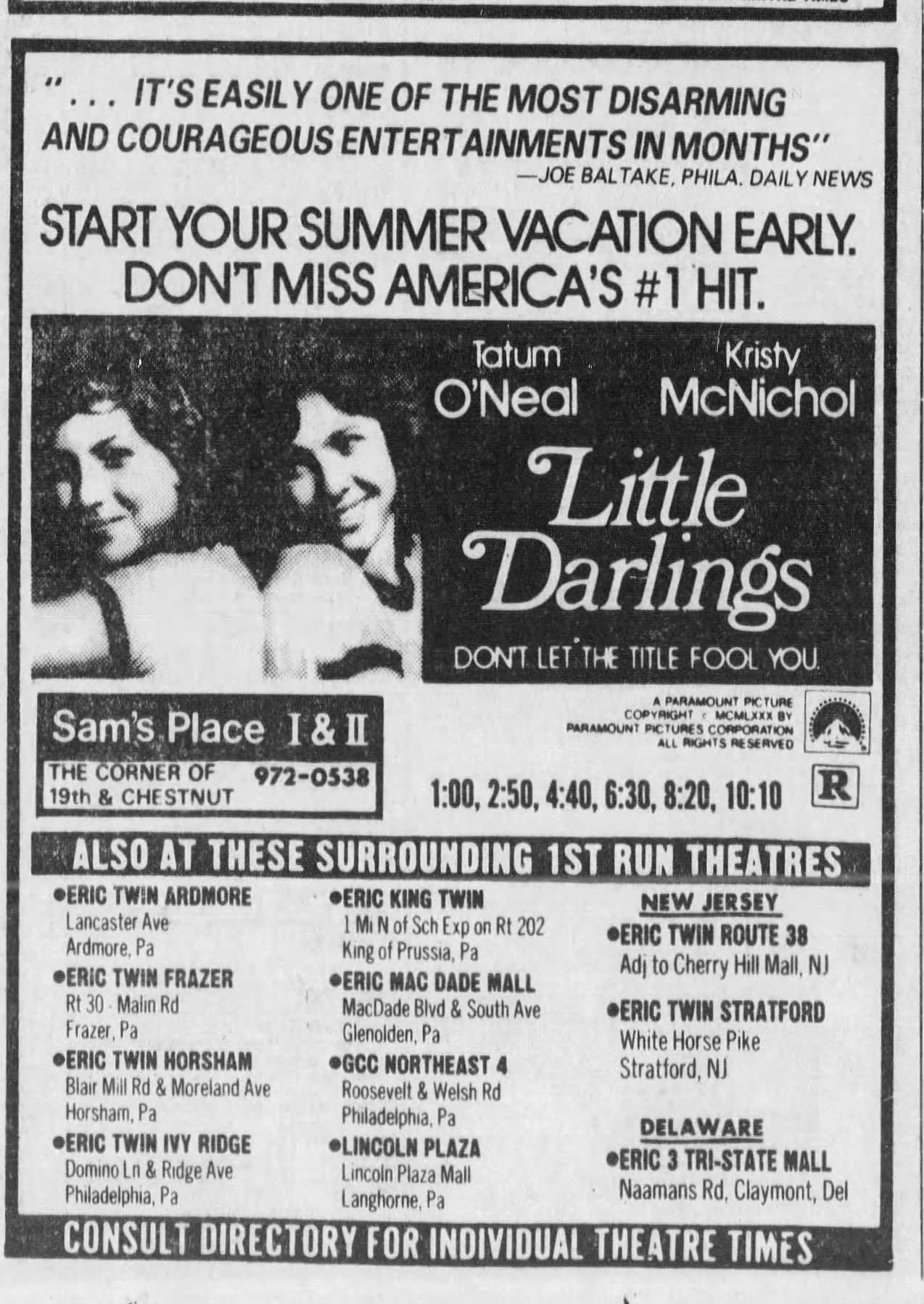
The other night, I clicked play on a movie I last saw in the spring of 1980, when I was 14: Little Darlings, which stars Tatum O’Neal and Kristy McNichol. The plot is simple: Two teens—one wealthy, one not—compete to see who will be the first to lose their virginity during their stay at a lakeside summer camp. While O’Neal’s character, rich girl Ferris, pursues a 20something camp counselor (Armand Asante), McNichol’s chain-smoking Angel woos a boy (Matt Dillon) from another camp. The film sounds randier than it is, with just light cursing, a few inoffensive bikini scenes, and ABC Afterschool Special-type moments mixed in with some silly hijinks. (I.e., food fight!) It’s less a distaff Meatballs, for those who remember the Bill Murray comedy also set at a summer camp, and more akin to the coming-of-age TV series James at 15. (Dub it Janes at 16.) Yet, due to its theme, the MPAA slapped it with an R rating.
The film’s restricted status meant that seeing it was something of a challenge for me. As with other R-rated fare, sneaking in depended on start time and the usher(s) working at the two-screen theater in my slice of suburbia. If a PG or G flick was booked alongside the R, you bought a ticket for the inoffensive fare and bided your time, exiting from it and “re-entering” the desired movie after a stop at the concession stand. At the one-screen theater closer to me, such moves were a no-go from the start, as the biggest obstacle was buying the ticket (the cashiers always cared more than the ushers), while a five-screen cinema umpteen miles away was out of the question, but for a different reason—my dad didn’t subscribe to the drop-off/pick-up arrangement other parents had with their kids.
In retrospect, the subterfuge needed to see such age-restricted wonders guaranteed that we kids left the theaters thinking they were better than they were; our excitement at sneaking in swept away our reasoning. Once cable TV made accessing the films as simple as changing the channel, however, we began to judge them on their merits—aka sans adrenaline. In fact, if I’m remembering correctly, by that spring my parents had subscribed to wired entertainment and, most importantly, the Philly-centric premium service PRISM, which featured theatrical films as well as the home games of the Flyers and Phillies.
But waiting a year-plus for a film to pop up on PRISM was out of the question—unless it never played the twin-screen theater near me, of course. As to Little Darlings, I primarily wanted to see it due to O’Neal, as The Bad News Bears was (and remains) a favorite; I also thought she’d handled herself well in International Velvet. McNichol, who I mostly knew from The Battle of the Network Stars, wasn’t a factor in my decision; I wouldn’t catch her much-acclaimed TV series, Family, until it popped up on the Tubi streaming service a few years ago. The TV commercial, if I saw it, didn’t play a part.
Anyway, at the time, I remember walking out of the mall-based theater into the glare of a Sunday afternoon—I took in the matinee because the Flyers were playing the Rangers in the NHL playoffs that night—impressed by the two leads but nonplussed by the story, which was written by Kimi Peck and Dalene Young.
After my rewatch? I somewhat agree with what Desmond Ryan, a Philadelphia Inquirer movie critic, wrote at the time: “A film that endeavored to tell us something about what has replaced the Victorian taboos of earlier generations would offer much of interest. On the evidence of Little Darlings, we are still waiting for it.” It never quite finds its footing, routinely teetering between sophomoric and sweet. (To borrow a line from the Jefferson Airplane, “Either go away or go all the way in.”) It’s not a sublime look at an age-old subject, in other words, with whatever box-office success it achieved likely due to the marketing campaign: “Don’t let the title fool you.”
One other thought: Some aspects of the story would never fly in today’s world, especially the (comical) attempted seduction of the camp counselor—and all the smoking! Wow. As with Times Square, a nowhere-near-similar coming-of-age movie, it strives for profundity but, aside from a few scenes, misses the mark. Still worth a watch, however.
 The Old Grey Cat