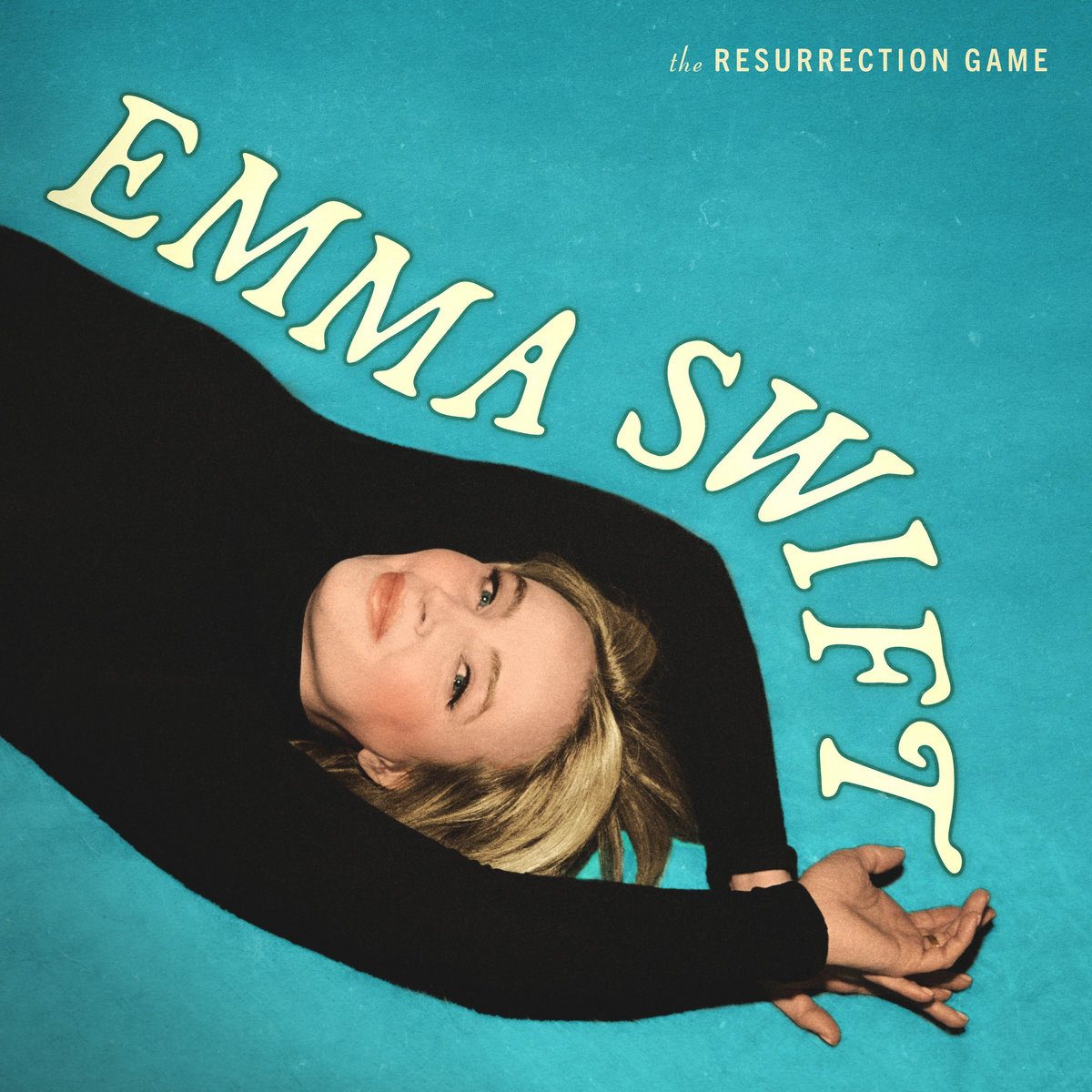
When last we heard from Nashville-based singer-songwriter Emma Swift, she expounded on today and tomorrow and yesterday, too, while musing about Edgar Allen Poe, Anne Frank, the Stones, William Blake, and Frederic Chopin. She personified—by way of Bob Dylan—a line from Walt Whitman: “I contain multitudes.” That was early in the pandemic, aka mid-2020, and the album in question was Blonde on the Tracks, an all-Dylan collection that mined new meanings from the grizzled bard’s songs. Five-plus years later and, with the sumptuous The Resurrection Game, it’s evident that she contains even more multitudes than we realized back then.
It’s a remarkable album—and a throwback to an era when strings underpinned soul-baring songs. The moody set reminds me somewhat of Bruce Springsteen’s Western Stars, which channeled everything from Glen Campbell’s cosmopolitan country sides of the 1960s to Burt Bacharach’s artful collaborations with Dionne Warwick. At the same time, it conjures the retro-soul of such modern singer-songwriters as Ella Thompson and Jalen Ngonda, not to mention Rumer circa Seasons of My Soul. Her melodies are multilayered and compelling, while her vocals ride the strings toward the sky one moment and plumb the ocean depths the next. The soundscape is dramatic throughout; one need not pay attention to the lyrics to understand the emotions driving the songs.
Of course, many of us do listen to the lyrics. Swift proves herself to be a poetic wordsmith—a la Jimmy Webb or Hal David, to continue the comparisons above—with her lyrics delving into matters of the heart, soul and mind. As she notes on the album’s Bandcamp page, “The songs are about romance, desire, my real-life nervous breakdown, spirituality, hope, and radical self-acceptance.” I could well delve deep into a song-by-song analysis, I suppose, but it almost seems beside the point. The Resurrection Game is best experienced in full.
About that breakdown: In mid-2023, while in the UK, she suffered a mental lapse that led her to seek help in her native Australia, where she spent about six weeks in care. One need not have endured the same to appreciate the album, I hasten to add; most everyone has experienced ups and downs, good times and bad. Too, Swift’s use of metaphor means that her lyrics transpose to the specifics of our lives—and, even if not, it’s one strand in a multi-hued quilt.
In that respect, “No Happy Endings”—which was released as a single a while back—is an excellent representation of the album as a whole. Lyrically, it celebrates love in the time of cholera; as she explained in a Substack essay, it’s “a love song about being a deeply romantic person in deeply unromantic times.” Another stunner, “Catholic Girls Are Easy,” peels away the sentimentalism that too often cloaks coming of age; it’s a messy and conflicted time, with pressures internal and external at play. The closing “Signing Off With Love” finds the strings serving as a bed for Swift’s musings on her depression and the fear of how it’s impacted her relationship: “I’ve used up all my happiness/I’ve used up all yours too/Is this what Maggie Nelson meant/When she said she loved/The colour blue?”
It’s a great album. Seek it out.
 The Old Grey Cat
One thought