
I’m in a bit of a nostalgic mood this morning, mired in memories and music that resonates beyond the synapses and into the heart. I remember a time, a place, a dead-end street like a lot of other dead-end streets, with our home the last one on the left, and my 15-minute commute to work—i.e., the 1990s, before the world turned mad. Those were days of hour-long lunch breaks and sparse traffic; it was routine for me to saddle up the Dodge Colt and ride home at noon. Philadelphia’s WXPN-FM, which some called singer-songwriter central, was a frequent companion.
Back then, the station’s deejays spun rich mixes that spanned the stylistic gamut—much as they still do, to an extent—though, and this may well be due to the hours I tuned in, the focus was primarily on the era’s nascent Americana scene, which encompassed country-tinged and folk-flavored artists. Singer-songwriter Heather Aubrey Lloyd would have fit right in. Her folky songs sport fleshed-out arrangements, while her lyrics feature a reporter’s eye for detail.
Her subjects range from the floods that ravaged her hometown of Ellicott City, Md., in 2018 to Syrian lovers surviving in the rubble of their country’s civil war to grief to matters of her own life, including the anxiety that plagues her and dreams delayed and possibly dashed. “Hometown Hero” speaks to the last: “‘Cause every dream stops dead at a truth/You can’t accept or can’t break through/but I hear they let anyone sing/as much as we want at the kitchen sink.”
Hers has been a circuitous journey, I should add. A longtime member of Baltimore’s alt-folk ilyAIMY (i love you And I Miss You) collective, with whom she still plays, she hit her solo stride during the ‘10s, turning ears with her 2017 album A Message in the Mess and then receiving acclaim at the Telluride Folk Festival that same year and New York’s Falcon Ridge Folk Festival in 2018. She also won the grand prize in the Bernard/Ebb Songwriting Awards of 2019—no small feat. As she began work on a followup album, however, the studio where she was recording had its equipment stolen. Then the pandemic hit. Life stalled.
She wouldn’t return to the project until 2022, when she flew to Reno to work with producer, engineer, and arranger Joel Ackerson—but the bad luck streak at recording studios continued when, a few years later, wildfires threatened Oak House Recording, where mixing engineer David Peters was working his magic on her finished songs. As she says in the press release, “Creating this album was like anxiety immersion therapy.”
In short, Panic Room With a View is a wonderful album that—as I said up top—inadvertently spurred a yearning in me fora time when folk-flavored singer-songwriters were legion on the radio and in music clubs. Those were the days, my friend. Those were the days.
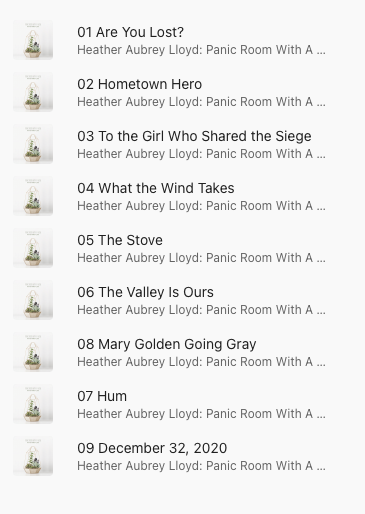
The tracks:
 The Old Grey Cat