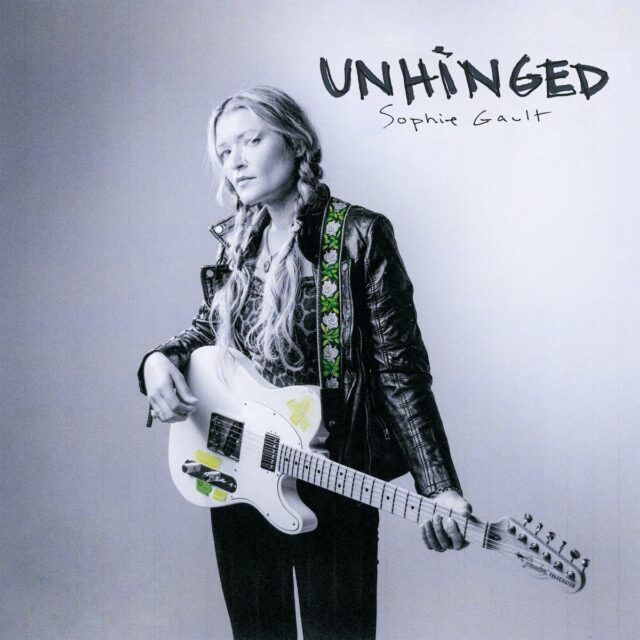
I’m not late to the party, just to the review. Some albums you play, and play again, for no other reason that they blow you away. You don’t think. You feel. And when it comes time to put your thoughts into words, you’re unsure of what exactly to say. Such is the case with Sophie Gault’s third long player, Unhinged, which was released a few weeks ago. It’s raw and raucous, kerosene-soaked (i.e., combustible), reminiscent to an extent of Steve Earle’s post-rehab classics I Feel Alright and El Corazon. To borrow a phrase I used way too often on the original Old Grey Cat website, including about those albums, it rocks the gut even as it connects with the intellect.
The 10-track set ignites with a cover of Buck Owens’ “Love’s Gonna Live Here,” which topped the country charts for 16 weeks in 1963. She ups the electric guitars and tempo, turning it into a rollicking declaration that demands “no more loneliness, only happiness.” “Pocket Change,” which follows, is another hard-chargin’ cover, this time of a Mando Saenz song—he’s a noted (and much covered) country songwriter, for those unaware, and chimes in on backing vocals. The self-penned “Merlot Dodge Dart” swaps the rock quotient for a moody remembrance of keying an ex’s car. Robert Johnson’s “Stop Breaking Down” is recast as a stompin’ blues—a warning sign to would-be paramours, in a sense.
“Chestnut Street” drives down a more traditional country road about an unfaithful beau, while “Stowaway” finds her catching an unbidden ride “in the cruise ship” of someone’s heart. A swell of guitars crashes across the ship’s deck as if towering waves. The title track slows things down while digging into the punch-drunk moments we all experience from time to time—maybe at a concert, maybe in the car when a certain song comes on the radio, maybe while walking with the one we love. The tears-in-your-beer “Whiskey Would Help,” written by Adam “Ditch” Kurtz, ups the rock quotient again while celebrating the anesthetic quality that alcohol has on heartbreak, while the rollicking “Last Call Rock and Roll” does the same.
The album closes with a sterling—and acoustic—rendition of Gurf Morlix’s “Is There Anyone Out There,” about the isolation many experienced during the COVID-era lockdowns, but Gault flips the script ever-so-slightly, injecting glimmers of hope into what could be heard as a call to what follows this thing we call life: “Something over the horizon/Whispers to me, I can’t deny/Words that I never heard/I understand, don’t ask why.”
In another era, while listening to it over and over again, I’d have laid on my bedroom floor with the LP jacket before me, scanning the lyrics while Gault spits ‘em out—or, decades onward, sat on the living-room sofa or in my den reading along in the CD booklet. I’d know every player on every track, and be eyeing the local clubs for when she came to town. I’d obsess over Unhinged, in other words—and, lack of physical media aside, that’s what I’ve been doing this past good while, cranking it up a time or three (or more) most days. It’s country, rock, bluesy and boozy—and damn good.
 The Old Grey Cat