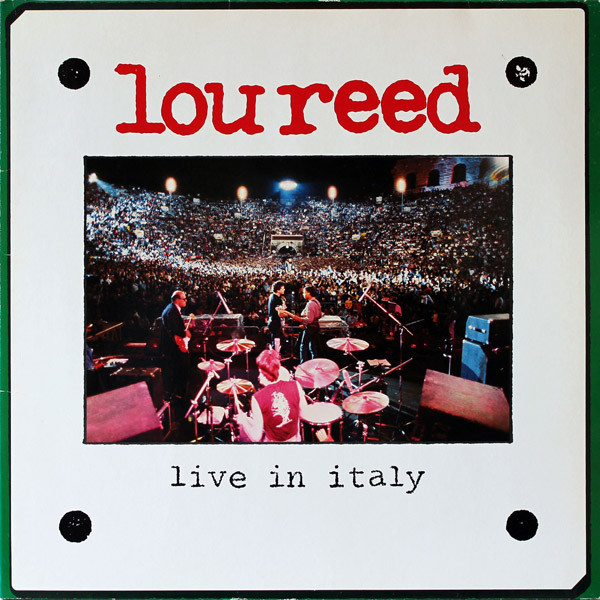
Flashbacks to eras and epochs past: That’s what music, at times, sparks. I’ve spent much of the past few years grooving to new sounds, as this blog shows, but of late have found myself dreaming of decades long departed. The other week, out of the blue (my my, hey hey), I woke to waves of guitars splashing from the recesses of memory: “Waves of fear attack in the night,” spit Lou Reed from a distant shore. The unsteady sea from which the tumult rose was not The Blue Mask (1982), the song’s studio home, but Live in Italy (1984), a high-decibel set that, in the U.S., was a hard-to-find import.
As most Philly radio aficionados in the late 1970s and early ‘80s can attest, Lou Reed’s “Walk on the Wild Side” and live rendition of “Sweet Jane” (from Rock ‘n’ Roll Animal) were semi-staples on the region’s two AOR stations, WMMR and WYSP. Those songs led me to pick up the 1977 best-of, which I liked, but it wasn’t until my senior year of high school, aka 1982-83, that I began exploring Lou Reed’s oeuvre in earnest—and not because of rock radio or that best-of. I read Jean Stein’s Edie Sedgwick: An American Biography, about the onetime Andy Warhol “superstar,” which led me to deep-dive Warhol, the Factory and, of course, the Velvet Underground. Lou Reed was in them?! Huh?! One purchase led to another, with some coming cheap from the RCA Music Club and others even cheaper from a used-record store. (It helped, too, that my great aunts gave me a bucketload of cash for Christmas!)
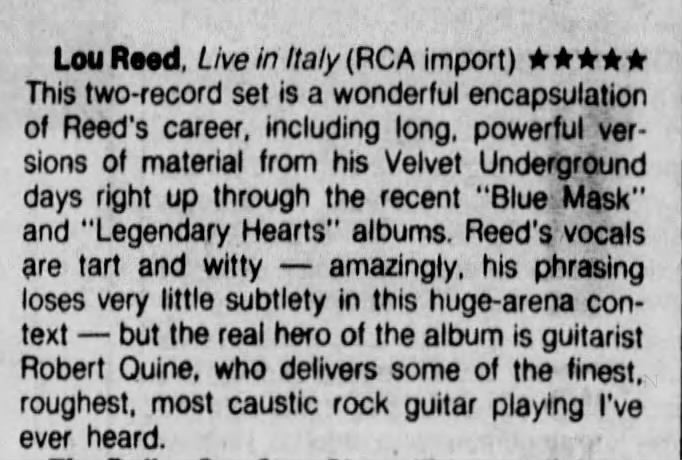
Smash cut to the spring of ’84, by which time I was a commuter-college kid and part-time movie theater employee: Live in Italy, although an import, garnered mentions in both national music magazines and the local press. The Philadelphia Inquirer’s Ken Tucker, who gave the double-LP set five out of five stars, opined that “the real hero of the album is guitarist Robert Quine, who delivers some of the finest, roughest, most caustic rock guitar playing I’ve ever heard.” Other critics, not that I knew it at the time, were likewise high on the album: the Daily Oklahoman’s Todd Webb, for example, concluded a rave review by claiming that the album “proves you can take the rock ’n’ roll out of the animal, but you can’t take the animal out of rock ’n’ roll.” The Oregonian’s Rick Mitchell, for his part, observed that Reed reins in his band (Quine, bassist Fernando Saunders, and drummer Rick Maher) through the first half before “kicking down the doors on the Velvet opuses ‘Sister Ray,’ ‘Heroin’ and ‘Rock and Roll.’ Quine is the most texturally-attuned guitarist Reed has ever worked with, and Saunders has a surprisingly round, lyrical bass tone.” I recall Musician and other magazines giving it similar praise, but that may be my memory playing tricks on me. (Let’s hope, one day, someone creates a newspapers.com for out-of-print magazines!) Not everyone loved it, however. Peter Anderson in the Herald Express of Devon, England, said, “Some songs adapt magnificently to the bare live sound of guitar, voice and drums—unfortunately Lou Reed compositions are not among them.” He called the songs “pale shadows of their former selves.”
In any event, the double album never hit the racks of any store by me—that I was aware of, at least. It wasn’t until late 1985 or early 86, by which point I was a college junior at Penn State’s University Park campus, that I stumbled upon it—in the racks of City Lights Records, for fellow Nittany Lions who recall the State College store. I hightailed it to my dorm room, lowered the stylus to the groove and…yeah. It’s possesses what I’ve come to call brutal grace—or, if you’d rather, an elegant ferocity. Reed and Quine’s electric guitars drive hard throughout, while Saunders’ reverberating bass echoes through dimensions, just about, all while Maher pounds a steady beat.
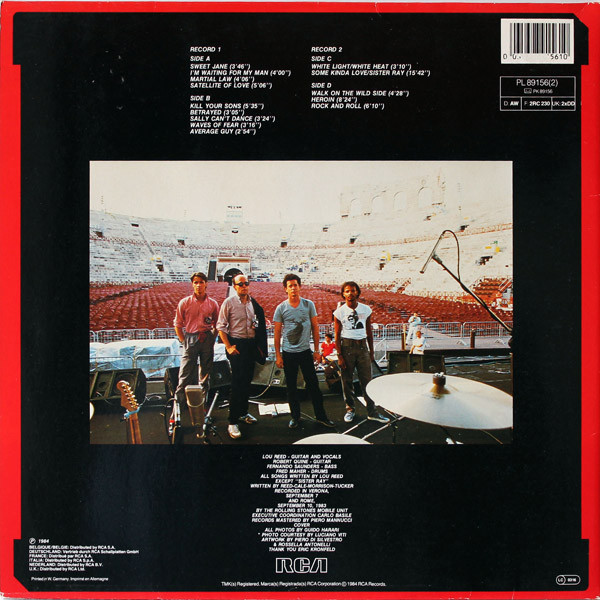
The set was recorded on September 7 and 10, 1983, in Verona and Rome, and features recent songs (“Martial Law,” “Betrayed,” “Waves of Fear,” “Average Guy”), a few ‘70s gems (“Satellite of Love,” “Kill Your Sons,” “Sally Can’t Dance,” “Walk on the Wild Side”) and a slew of VU classics (“Sweet Jane,” “I’m Waiting for the Man,” “White Light/White Heat,” “Some Kinda Love/Sister Ray,” “Heroin,” and “Rock and Roll.”) The biggest surprise, I think, is the inclusion of the three Sally Can’t Dance tracks, given that Reed claimed to hate it. Whatever the case, the result is a staggeringly powerful outing despite—as Anderson lamented—the lack of keyboards and backing vocals. Reed, Quine, Saunders and Maher are a beast of a band. The performances of the newer, older and classic songs are mesmerizing, all.
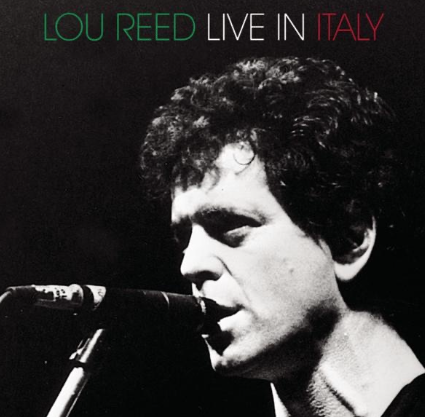
In short, Live in Italy is well worth many spins. (Oddly, though, the cover art changed—at least for the U.S. market—at some point. Why? Who knows.)
 The Old Grey Cat