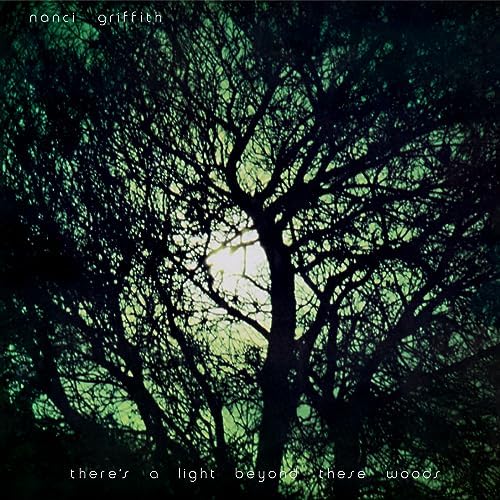
Days of yore dissolve into weeks, months and tears while we speed along the highways and byways that make up life. The years of wasted miles are akin to litter on the roadside, though certain memories remain in the rearview mirror throughout the journey. I don’t recall when the specific day fell on the calendar, for instance, just that it was an early weekend morn in the mid-1980s, when I was one of several rotating hosts of The Folk Show on Penn State’s student-run radio station at the time, WPSU. I usually spun discs from 6 to 10am and, this day, queued up the first side of a Fast Folk Musical Magazine compilation. Nanci Griffith’s “Daddy Said” barreled through my headphones and, whoa! I remember rushing to the record library in search of other releases by this new-to-me singer-songwriter and coming across her 1978 debut, There’s a Light Beyond These Woods—but it could have been the following weekend. Either/or, I played the title track. It blew me away.
I eventually “borrowed” the LP in order to listen to it in my dorm room—and, yes, I returned it. How else could I play “There’s a Light Beyond These Woods (Mary Margaret),” “Song for Remembered Heroes” or “Montana’s Backroads” on the air in the weeks that followed? For those who know Nanci best from her MCA days or Grammy-winning Other Voices, Other Rooms, the set is more folk than the “folkabilly” she later forged, though country overtones can be discerned on several tracks. The acoustic-driven numbers feature rudimentary backing—a banjo here, cello there, plus backing vocals from such friends as the Mary Margaret of the title track, Maggie Graham. The tunes were recorded at Pecan Street Studios in Austin, Texas; as Nanci told Bruce Whitman of Vermont’s Brattleboro Reformer in a September 11, 1986, profile, “It is a beautiful album. It is a live two-track album put together by Rick West. It’s not the type of first album that you want to sweep under the bed.”
I’d add that it’s beautiful despite its imperfections. Nanci, just 25 at the time of the sessions, was already a veteran of the club scene and is obviously comfortable giving life to the songs, seven of which she wrote. But there’s often a disconnect between the performances and the songs themselves. As a result, I hear the album as a young artist in the process of becoming.
One example: the first track, “I Remember Joe.” She picks the strings of the acoustic guitar just as she does on so many of her now-classic songs. Her voice rises and recedes, conveying an intimacy at odds with the lyrics, which recount the story of Sheriff Joe Mason (1840-81) and America’s oft-bloody push westward: “Joseph wore that badge/Across the Kansas prairies to save the railroads/But the heroes that we made, well, they were/Ruthless soldiers who’d kill for gold.” (She mined similar terrain to better effect on One Fair Summer Evening with her cover of Eric Taylor’s “Deadwood, South Dakota.”)
“Alabama Soft Spoken Blues,” cowritten with the aforementioned Maggie Graham, foreshadows several songs yet unwritten, with a stirring arrangement that’s a perfect accent to the lyrics about a sweet-talking southern man. It’s fully developed and would’ve been at home in Nanci’s repertoire at any time in her career; it’s a shame that she left it behind.
“Michael’s Song,” on the other hand, is a story-song/character portrait that never jells, though it does include a line that’s remained with me since I first heard it: “Michael counts his songs in the years of wasted miles.” As I’ve said of other folksongs by other artists, the lyrics are overly earnest—and, here, shoehorned into a meandering tune. That it’s sandwiched between two strong songs amplifies its weakness. “Song for Remembered Heroes,” which follows, is a well-crafted portrait, with lyrics that tackle time, memory, heroes and more.
“West Texas Sun,” on the other hand, is as flat as the West Texas desert.
By now, I’m sure, some readers are wondering why I deem an inconsistent debut—as that’s what, at heart, the album is—an “essential” listen. I can explain in three words: the title track. “There’s a Light Beyond These Woods (Mary Margaret)” is a stellar song that chronicles Nanci’s friendship with Maggie Graham, who she met when she was 10. It’s reflective, mournful and celebratory all at once, a work that’s guaranteed to spring forgotten moments from the listener’s own youth. Everyone has dreams missed and achieved, after all. Everyone loses someone. Friendships, too, come and go, though—for the lucky—some span a lifetime. The arrangement isn’t as pristine as it would become by the time Nanci re-recorded the song for Lone Star State of Mind—or as stirring as her live renditions—but that’s okay. It’s still tremendous.
That it’s followed by a song written and sung by Eric Taylor, Nanci’s husband at the time, is odd. “Dollar Matinee” tells the story of a guy who sees an old flame on the big screen—and serves as something of a sonic speed bump on what is, after all, a Nanci Griffith album. The exit that follows, “Montana Backroads,” was written by folkie Bruce Carlson; it captures the essence of a lonely old-timer holding on the best he can: “In an old pickup truck, with his hat pulled down/He drives them old Montana backroads/Remembering half-forgotten times, and wondering where it’s gone/And if he can still carry the load.” It’s everything “Michael’s Song” isn’t. The final track, “John Philip Griffith,” is a well-intentioned tribute to Nanci’s grandfather set to another meandering melody; as with “Michael’s Song,” its lyrics strive for profundity but come up short.
As many a Neil Young fan can attest, imperfections can make a song or album a fascinating listen. Such is the case with There’s a Light Beyond These Woods. The pieces are present, but the puzzle’s picture has yet to come into view. Poet in My Window, which followed five years later, fit more of pieces together, with the picture finally coming together on Once in a Very Blue Moon in 1984. (That’s part of what makes the Working in Corners box set, which gathers her first four albums together, such a marvelous release; it essentially tracks Nanci coming into her own, false steps included.)
Contemporaneous reviews for the album’s original release in 1978 aren’t available on Newspapers.com, unfortunately. The 1986 re-release on Philo did spur David Hinckley of the New York Daily News to mention it in a January ’87 roundup, however; he gave it three stars and wrote: “A delightful folk record, full of catchy, perceptive tunes (like the title cut) and lovely singing.” I’d call it delightful yet flawed, a fascinating listen because of what we know is yet to come. Give it a spin. Its highs are sublime, while its lows don’t last long.

 The Old Grey Cat
That first album was self financed. She sold most of the copies at her gigs at really small clubs. At the time she recorded it, she would not know if her career would ever take off beyond what it had been for the several years before. That album did not change much, but the next one was a launch up and caught the ear of the right people. It got her out of the same old routine that was beginning to frustrate her. There was a light beyond these woods. Nanci was the real thing and she stayed true to herself.
LikeLike