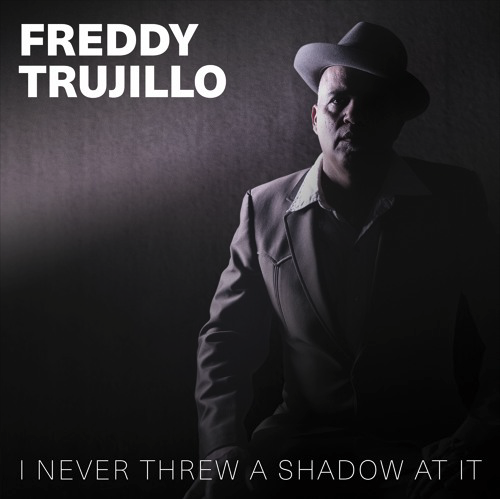
Imagine calling the police to report the attempted theft of your car from outside your home only for the responding officers to handcuff you. That incident, which happened to Delines bassist Freddy Trujillo as a young man in 1990s-era Los Angeles, fuels the title track of this, his fourth solo outing. The album conveys his experiences growing up Chicano in Southern California, ably portraying life’s joys as well as the flip side.
Guitars ring out on the 10-track set (though not on every song), catchy rhythms rise and fall, horns occasionally punctuate the goings-on, and Trujillo’s vocals give life to his sharp lyrics, such as the cutting “I Didn’t Cross The Border, the Border Crossed Me.” (It may come as a surprise to the history-challenged among us, but Mexican culture in the American Southwest predates those states and their borders.) Other songs delve into the small wonders that make up a life, such as the picturesque “Windows,” which features Patricia Rojas on violin and backing vocals. Other guests include his Delines bandmates, plus guitarists Ag Donnaloa and Kenny Coleman. The Delines’ Cory Gray, it should be noted, engineered and co-produced the songs at his Old Unconscious Studios.
Speaking of the Delines, Willy Vlautin wrote the lead-off song, “Corpus Christi,” for the group’s last album but, when it didn’t fit with the project, Trujillo asked if he could record it himself. It’s bouncy and propulsive, a perfect opener, and fits in with the album’s over-arching theme. “World There Haunting Me” is another standout track, delving into the claims we always hear—work hard and good things will come—only to articulate the reality that life doesn’t always unfurl the way we hoped. Sometimes we’re left with little more than what we started with. “Many Years of Minding,” which closes the album, is a cogent summary of the middle-aged Trujillo’s thoughts on racism, both obvious and not. In many respects, it and the preceding songs remind me of Garland Jeffreys’ classic—and oft-overlooked—1992 album Don’t Call Me Buckwheat. (That’s high praise.)
While the musical style obviously isn’t that of the Delines, most songs share a similarity with that group’s cinematic endeavors. Dramatic scenes with fully formed characters routinely fill the screen. In short, they’re movies of the mind well worth one’s time.

 The Old Grey Cat