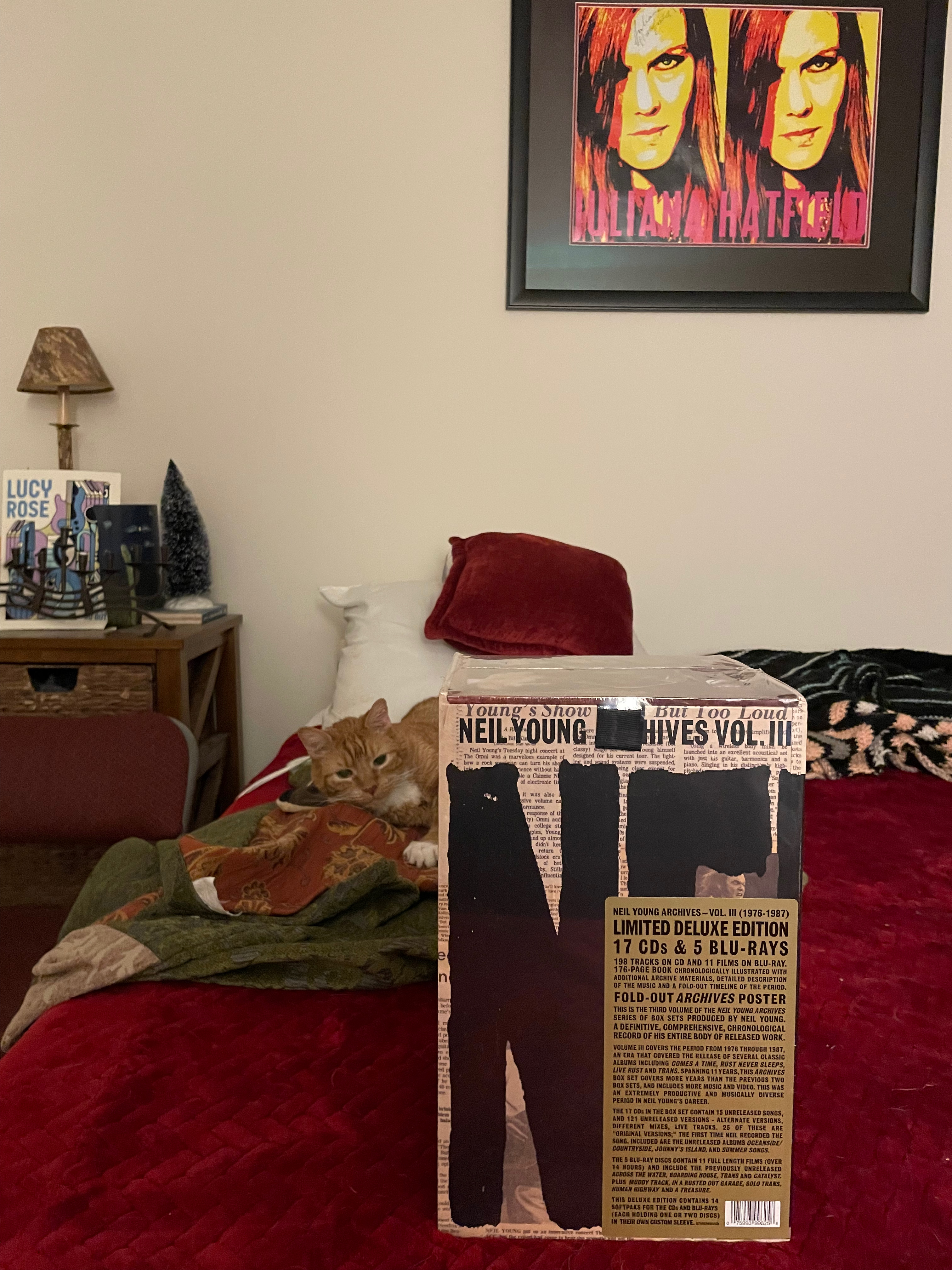
Two Saturdays ago, as I noted at the time, I was in the midst of downloading Neil Young’s massive Archives Vol. III compilation—27 gigs worth of music. The “download all” option petered out each time I attempted it, however, leaving me with multiple copies of the same tracks. Other files threw server-side errors, so never downloaded, while quite a few arrived in corrupted form. As awful, the songs that did successfully navigate the Internet’s chutes and ladders to land in my downloads folder lacked the metadata tags needed to arrange them in order.
The set was released the day prior, of course, but the physical version—17 CDs and five Blu-Rays—wasn’t slated to reach me until Wednesday the 11th. About the only good thing about ordering from the Neil Young Archive’s Greedy Hand store is that LPs and CDs come with downloads from the associated high-res store. So, though my experience has always been that shipments reach me late, the lag isn’t that big a deal—you have access to the music, after all. Too, with past releases, the album was available to stream from the NYA website and app, plus from the big guns (Apple Music and Spotify), on the day of release.
Such was not the case with Archives Vol. III. One fan reported that an NYA staffer said on the Steve Hoffman Forums that it was being kept off the streaming services until the physical sets sold out. Whether that’s true, I can’t confirm; I’ve yet to locate the post in question. It makes sense, however. Why buy the cow when the milk can be had for a small monthly fee? What didn’t compute was keeping it off the subscriber-based NYA site—but, based on a note Neil shared the following week, its absence wasn’t intentional. They were experiencing server-related issues, too.
Anyway, each of my successive “download all” attempts ended the same as those first few—and revealed no pattern to the errors or issues. Early Sunday, I realized there was but one potential solution: downloading the files one by one. When an attempt errored out, as many did, I tried again and again until it succeeded. If a file arrived one-tenth of its expected size, I clicked “download” a second, third and even fourth time. And, indeed, by 10:47am, my approach paid dividends: I had all the files on hand! Song order, however, remained an issue due to Macs not showing the seconds in the “date modified” column; files that shared the same HH:MM timestamp were jumbled—mostly Neil’s short raps and the songs on either side of them. I spent the next hour adding numbers (001 to 222) at the beginning of each file name to fix that problem.
I share that struggle because, at times, such ancillary stuff can color our perceptions. It’s not a great analogy, I admit, but it’s somewhat akin to going to a concert only to be seated near jerks who yak their way through the show. No matter how good the performance, your enjoyment is muted. A better analogy: booting up a new computer for the first time only to discover the OS was never installed.
Returning to that Sunday: I initially played the sections that most interested me. “Snapshots in Time,” for instance, captures Neil unveiling a slew of mostly new songs to Linda Ronstadt and Nicolette Larson while sitting with them and David Briggs at a table in Linda’s Malibu home in 1977; the songbirds add harmonies here and there. Another stretch of songs hails from a rehearsal with Larson and the Gone With the Wind Orchestra for a one-off Miami concert that same year. A live set at the Boarding House in San Francisco, circa ’78, features mesmerizing acoustic spins on songs old new, including “Shots” and “Powderfinger.”
In the weeks since, I’ve listened to the set from start to finish—albeit with numerous stops and starts along the way—and revisited specific sections many times. I’ve also, as the dispatches I’ve posted over the past two weeks show, listened to more than just it. New releases from Sophie Gault, Lea Thomas, Malin Pettersen and Hayley Reardon all left me spellbound. (FYI: If you enjoy Neil’s acoustic musings, you’re sure to enjoy Reardon’s.)
In short, Archives Vol. III is a deep dive into Neil Young’s oeuvre from 1976 through ’87. It features a bounty of unreleased material, a fair bit that’s been bootlegged (and, thus, well known to many of us), plus 77 tracks from albums he released in those years plus a few of the archival treasures he shared with fans in the years since. (Wikipedia has a thorough rundown of what came from where.) The biggest issue I have with the set is the sprawl. As I mentioned in my spin on the one-CD/two-LP “best of” Archives Vol. III Takes, it would have been better to split it into two—’76 to ’81 and ’82 to ’87—and, now that I’ve listened to it in full, exclude some of the previously released material.
The first half is stellar. It includes much-bootlegged live sets from 1976 (Budokan Hall in Tokyo and the Hammersmith Odeon in London). There’s no overlap between these tracks and those from the same shows that appeared on Archives Vol. II and the stand-alone, LP-only Odeon Budokan archival release. Previously shared tracks from the Homegrown and live Songs for Judy archival releases are also present, as are a few tracks from The Last Waltz.
The Snapshot in Time section on Disc 4 is a treat. Linda and Nicolette provide makeshift harmonies on a several songs, the bulk of which are new to them. An outtake of “Barefoot Floors”—which Nicolette would record and release in 1994—is very sweet. Disc 5 features the Ducks, with most (though not all) of the tracks previously issued on last year’s archival High Flyin’ “official bootleg”; the non-Neil songs remind me of Waylon Jennings, which is to say they’re kinda cool. As with Songs for Judy, I never purchased that stand-alone album so don’t mind its inclusion here; fans who own both, however, may well be annoyed at buying them a second time. Disc 6 features Comes a Time-era recordings—different takes and/or mixes from the album, all enjoyable. The same holds true for Disc 7, which includes the aforementioned rehearsal with Nicolette Larson and band at the Nashville Musicians Union Hall, plus a few unreleased gems recorded at Nashville’s Sound Shop recording studio.
Discs 8 and 9 are almost worth the price of the package altogether. The tracks hail from a series of acoustic shows at the Boarding House in San Francisco in May 1978; Neil performs a mix of new and old tunes—and is in the zone throughout. The acoustic “Shots,” later a highlight of the electric re*ac*tor album, blows the mind, while “Thrasher” is as stirring as ever. Discs 10 and 11 contain quite a few Rust Never Sleeps, Live Rust, Hawks & Doves and re*ac*tor tracks alongside a few unreleased tracks. The H&D outcast “Winter Winds” is a country-flavored gem, for instance, while “Sunny Inside” from the re*ac*tor sessions is a frolicsome precursor to his rockabilly-flavored Everybody’s Rockin’ album.
Disc 12 kicks off with a half dozen tracks from Trans, his Geffen Records debut, followed by selections from the unreleased Johnny’s Island album (aka Islands in the Sun). They’re solid songs that conjure his early ‘70s excursion into the middle of the road. That he ditched them, then, isn’t much of a surprise. Disc 13 switches on a dime to the countrified sound of the original Old Ways, followed by his embrace of rockabilly with Everybody’s Rockin’.
Disc 13 also features Neil’s attempt at a one-man band on six songs. It simultaneously echoes the non-vocoder Trans tracks while foreshadowing the stereotypical ‘80s sound he achieved a few years later on Landing on Water. “Razor Love” is the standout; he would have scored a big MTV hit if he’d released it at the time. A much-bootlegged live set from the Catalyst in Santa Cruz follows on Disc 14; it finds him and Crazy Horse performing a mix of new and old songs to varying success.
That he opted to continue with the Grey Riders, the band that backed him during his excursion into country music, isn’t much of a surprise. Disc 14 showcases their live prowess via an array of unreleased performances coupled with select highlights from the archival A Treasure set he released in 2011. “Amber Jean,” for his daughter, is a delight, while “Get Back to the Country” and “Are You Ready for the Country” are fun.
I do find it odd that, though Neil includes ample tracks from his released albums throughout, none hail from Old Ways (1985) or Life (1987). Instead, we’re treated—on Disc 15—to six songs from the appropriately named Landing on Water, which—aside from “Hippie Dream”—represents the nadir of his oeuvre. An early version of “Road of Plenty,” which would morph into Freedom’s “El Dorado” in a few years, almost makes up for it, as do the heartfelt “We Never Danced” and “When Your Lonely Heart Breaks”; they’re positively spellbinding.
The final disc features Summer Songs, which Neil shared with fans a few years back on the NYA site. It’s a stirring collection of songs that he’d release in re-recorded form on American Dream, Freedom and—in a few decades—Psychedelic Pill.
All in all, the 17 CDs (14 hours of audio) provide plenty of highs and, primarily in its second half, more than a few downs. It’s always fascinating, however. To that end: Although it’s 222 tracks in total, many of them are short “raps” in which Neil discusses the song or songs that follow. I wouldn’t recommend Archives Vol. III to casual or new fans, but do believe old-timers will find much here to enjoy—and, to be fair, complain about. (That’s par for the course when it comes to most box sets, however.) Was it worth the days-long downloading difficulties I experienced? Yes.
(The deluxe version, which is what I purchased, comes with five Blu-Rays that include nine concert films and an animated film by Micah Nelson that tells the Trans story; I plan to write about some of them in the weeks/months to come.)
 The Old Grey Cat
I agrée highly disapointed he passed over stills young . I would have liked a re mastered long may run album on This or volume 2 plus the csny versions .
LikeLike