My wife Diane, who previously penned a review of Bruce Springsteen’s Only the Strong Survive covers album for The Old Grey Cat, wrote the below for a Springsteen bulletin board she belongs to, then asked if I’d like for the blog. After a few light edits, here it is: a passionate, personal take on the Springsteen: Deliver Me From Nowhere movie.
*********
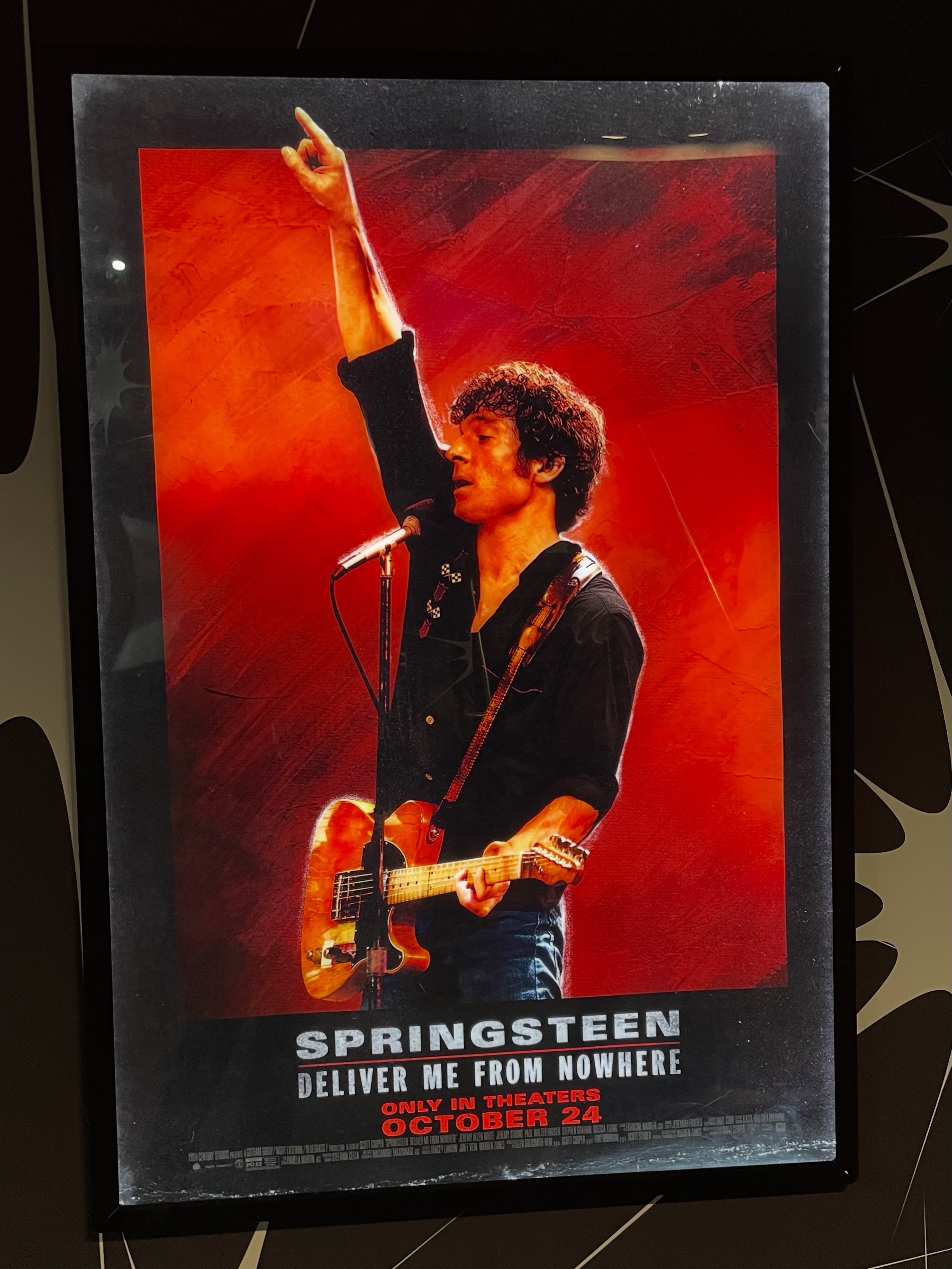
One of the things about being a critic of anything—music, books, art—is that how something hits you is always as much about you as it is the art, and it’s only your self-awareness of this fact that allows you to be effective.
Going in to Deliver Me From Nowhere, I was very aware of three things: that I am extremely intense, that Bruce Springsteen was my main passion for decades, and that he is now simply an artist I admire and am grateful to because he formed so much of my essence, but he’s no longer the center of my universe.
However, there was a time when I was so unclear on my own direction, I lived for the times I saw Bruce in concert and listening to his recordings was my frequent companion and succor. After reading Dave Marsh’s Born to Run in grad school, I had a context for my passion. Bruce Springsteen was my romantic fantasy, but he was so much more than that—he was my role model. I started immersing myself in a wide range of music, using the Rolling Stone Record Guide, also by Dave Marsh (with John Swenson). I studied it cover to cover, figuring out which artists I needed to explore more in order of priority and limited finances. Because R&B was what I really loved (and Bruce’s music was steeped in it, from his covers to his earliest work), that was where I spent the most time and money, but I also opened up to country, which was alien soil indeed for a Philly girl raised on rock radio. I read about and listened to Woody Guthrie because of Bruce. I read Flannery O’Connor because of Bruce. Wise Blood was inscrutable to this English Major first time around, and it was my first hint that Bruce’s darkness was a far cry from my Jane Austen inclinations.
But I read it again and again until I saw its beauty many years later. Because if Bruce found it worthwhile, it was, and I just had to dig deeper.
This is true of the Nebraska album as well, and it’s a stroke of genius and fortune that the wonderful Nebraska ’82: Expanded Edition set has been released at the same time as the Springsteen: Deliver Me From Nowhere movie. When I first heard it, I was a bit like the Columbia Records exec in the movie—“Is this it?” The music was so dirge-like, raw, and it did not have a beat—you could not dance to it. But in this lifetime, my lifetime, I believe in Bruce Springsteen and so I listened again and again. Now I recognize it as the great album it is, but Bruce made me stretch and learn. (The Suicide track, “Frankie Teardrop,” in the movie—I ain’t stretching that far.)
Okay, back to the movie. But I bring all of that background with me when I go to see a film like Deliver Me From Nowhere. I’ll be honest—when I saw the original preview for the movie, I thought the line about the hole in the floor/repairman for the world was so heavy-handed that I wasn’t going to bother seeing it until it came to cable, and even then I was ready to dislike it. But watching The Bear showed me how brilliant an actor Jeremy Allen White is, and a friend’s comment about wanting to see it on the big screen was a motivator to do so myself. From the first frames, I had mist in my eyes—that reconfiguring of the ’81 performance and the Clarence manqué grabbed my heart, because The River was MY tour—I was at the zenith of my Brucemania and went to 12 shows, traveling and making all sorts of sacrifices to feed my joy habit. Real life was a drag, but Bruce shows were euphoria, and I was going to live in those brief moments and the memory of them. That was my actual goal.
I also thought about Bruce constantly, analyzed him in my romantic but cerebral way, based on his lyrics and every interview I could get my hands on. And yet I had no idea how tormented he was. Dark and intense and moody, yes. But while my life contained trauma, it was such a different format of trauma that it was a world away from my understanding. And the romantic haze never allowed for Bruce’s level of mental illness, because while I started therapy on and off since my 8th grade year, it was situationally-based dysfunction rather than genetic, and I have come to realize that there’s a difference in regulation of that. Sometimes I wanted to go over the edge, but my firm grip on reality never let me dive.
My BFF, whom I met in college and infected with my Bruce obsession, was from a (South) Jersey working class background and I never really fit into it. It struck me that Bruce was more from her world as I watched the movie—I was just a visitor, and an awkward one at that. The movie captures that milieu completely. Matthew Anthony Pellicano as the young Bruce was excellent, and really looks the part. Jeremy Allen White is a fine method actor, but he looks nothing like Bruce and half the time I thought of him as Carmy-Bruce. But when he’s shot from certain angles, less in color than black and white, he is very Bruce-esque and he absolutely nails the musical aspect. I thought he inhabited the role as successfully as it could be done, but my bff decades ago said Pacino was perfect for the role, and I still can’t imagine anyone doing it better.
Stephen Graham, who plays Bruce’s father, has been acknowledged as great, and I concur, even though I identify him so strongly with his role in Adolescence that it was hard for me to diverge. Gaby Hoffmann as Adele wasn’t my vision of Bruce’s mom, but it clearly was of Bruce’s and I have to bow to his actual, superior knowledge.
While I am very glad to have seen the movie and will watch it again when it comes on cable, I do have my criticisms. It seemed like there were four false endings. The movie is (too) long; its content is not just relentlessly dark and the plot is not dynamic—it’s the making of a record and the unmaking and remaking of the human psyche. I dig that kind of thing, it’s not for every viewer. In addition, some of the dialogue was cringe-worthy, clumsy and banal.
Back in the days when I was crushing on Bruce, when I saw him in interviews I was turned off by his slow, monosyllabic communication. How could my street poet be so unalluring? My dialogue for him in my fantasies was so much better. The problem, of course, was that I thought I “knew” him so well, but I didn’t have a clue as to what he was going through or the darkness on his edge of town.
One of the most powerful scenes is when the Jon Landau character sits on the floor with him listening to a gospel song. I recognized Sam Cooke’s vocals because he’s one of the artists I studied in some depth, particularly my favorite album, Live at the Harlem Square Club. But I also bought the deluxe set of the SAR gospel recordings, though—if I’m honest—I only listened to it a few times and didn’t recognize “Last Mile of the Way” in the movie. But I wouldn’t leave until the credits rolled, because I wanted to see if I was right that it was Sam Cooke. It was, I was, and to me, that’s what remains from my youthful crush. The breadth of my musical knowledge, my politics and the way I think about the world—all of these have been so influenced by this man I devoted so much of my life and attention to. Life and illness have changed me, and what was on my mind most was going home to my new kittens and spending time with my husband—I don’t crave my old euphoria of being at a Bruce show. Live music is no longer life music for me. It’s just me and Jeff and the joy my kitties bring into my real world.
 The Old Grey Cat
Well done commentary
LikeLike