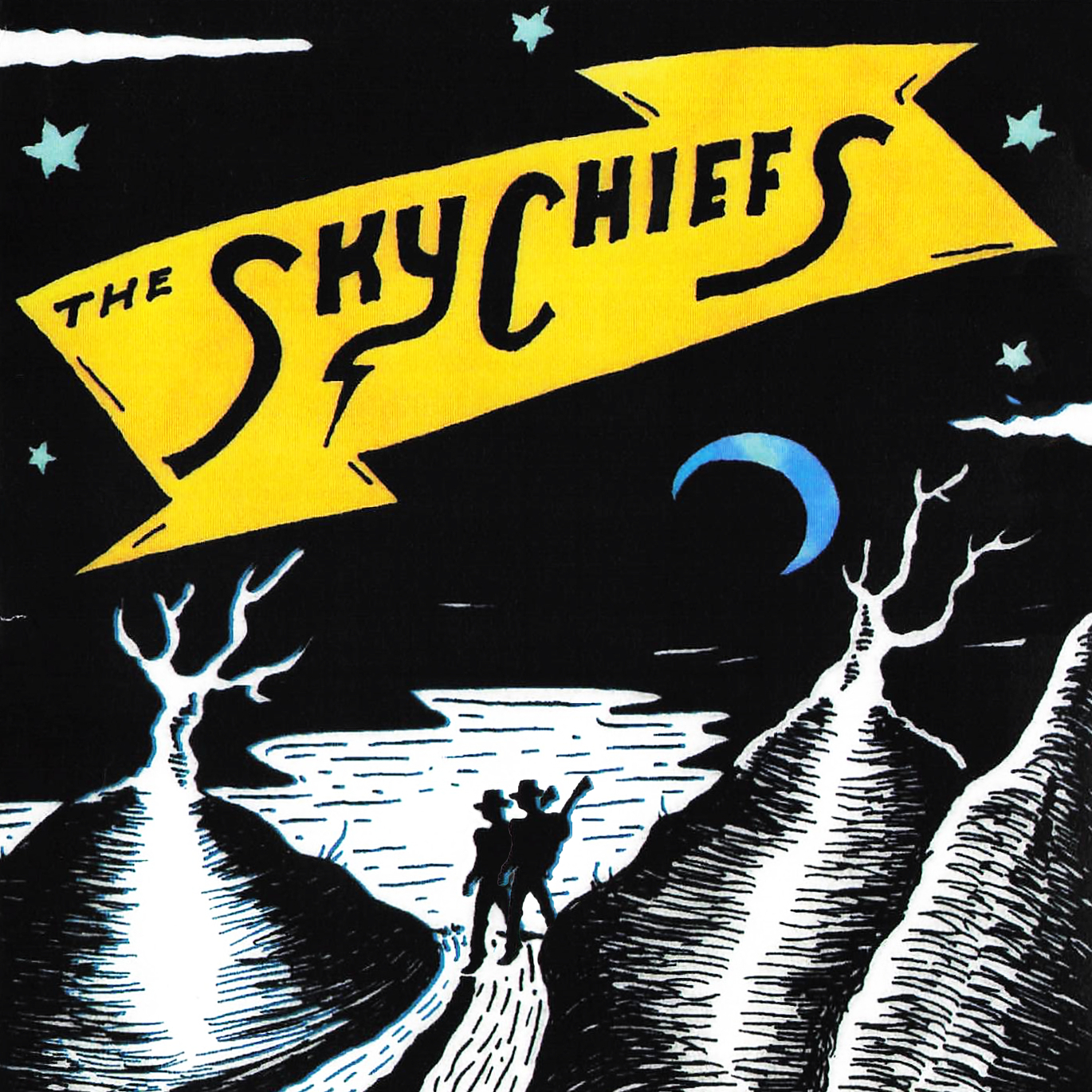
Strange the way days unfold. Of late, I’ve been playing the Sky Chiefs’ self-titled debut a time or two most mornings as it’s slated for release this Friday and, as always, I prefer living with an album before spotlighting it—my “first” impressions, in truth, are often (but not always) my 50th. I’ll get to the whys and wherefores of the Sky Chiefs in a few, but for now: I kept and keep hearing echoes of other artists, other bands, in their genteel grooves, from the Everly Brothers to Gram Parsons to the Long Ryders to the Jayhawks, with the second-to-last due to guitar-slinger Stephen McCarthy’s involvement. Yesterday morn, though, I detected something more: Jackson Browne circa his ‘70s heyday. Then, last night, while tuning in Johnny Carson on Tubi (yes, I watch old Tonight Show episodes from time to time), a 2012 Jackson Browne concert film shot in Denver appeared in the “suggested” section. What can one do when such a thing presents itself but click play?! Diane and I saw him on the same tour when he played Philly, by the way; the subdued show found him backed by a crack ensemble that included singer-songwriter Sara Watkins, who also opened, on supporting vocals and violin. “The Late Show” was absolutely jaw-dropping.
Anyway, I couldn’t help but to contemplate how Browne has influenced legions of artists and bands, including quite a few who would likely eschew the link. The Long Ryders, for instance, might prefer that people point to the Byrds, Buffalo Springfield, and Flying Burrito Brothers, not to mention fellow “prisoner of rock ’n’ roll” Neil Young; though lauded, Browne is identified with the soft-rock SoCal scene many folks deride, after all. Yet the influence—whether first-, second or thirdhand—is discernible on select songs. The same’s true of this 14-song set from the Sky Chiefs, a 1990s-era collaboration between the Ryders’ Stephen McCarthy and Kevin Pittman, perhaps best known for his work with the Dads, that came close to falling between the cracks of time.
McCarthy, of course, was and is the lead guitarist and frequent vocalist in the Long Ryders, responsible for such songs as “I Had a Dream.” After the group’s initial late-‘80s dissolution, he returned to his native Virginia and fell in with Pittman, whose band was an East Coast mainstay during the 1980s. There’s more to their stories, of course, but I’ll jump to their joint adventure in Pittman’s recording studio-slash-home, a 100-year-old Richmond bungalow. Over the course of a year, they wrote and recorded two dozen tracks with assists from a revolving cast of supporting players.
From first listen to the last, just now, the songs primarily conjure the Jayhawks to my ears—foreshadowing McCarthy’s stint with that band a decade on, in a way. They’re twang-filled delights accented by warm harmonies that sound as fresh today as they would’ve in the early 1990s, when the Adult Album Alternative radio format smoothed alt.country into the Cosmic American Music now known as Americana.
The album opens with “House Full of Company,” a song most everyone who’s had weekend houseguests will relate to: “Family heartaches came for the weekend/But I can’t get them to leave/Got no job and they just wanna rob me/Of my sleep and watch TV.” “No Happiness for Sale” is an extension of the same premise—i.e., finding no joy in the general store that is life. “Knocking Out the Daylights” flips the script by looking outward; though often remembered as an era of economic expansion, the Clinton years also gave birth to extremism and a coarsening of public debate. “Engines,” on the other hand, celebrates the pistons that keep firing despite the difficulties we sometimes encounter, while “Where I Wanna Be” celebrates how life’s left turns sometimes lead to love.
“My Last Goodbye” is one of the tracks that reminded me of Browne’s mid-‘70s works, while “What Lonely Means” reminds me of the post-Gram Parsons Flying Burrito Brothers. “The New Sara Jane” digs into the rebranding some folks use to differentiate their present from their past. The wry “Shadow Blues,” meanwhile, turns a missing shadow into a parable, while “Come Back Ophelia”—inspired by a relative with Alzheimer’s—explores how dementia essentially casts a person into a permanent shadow state. “Shine” and “Walk All Over Me” features Everly Brothers-type close harmonies, with the former a straight-up love song and the latter being a snappy ‘50s flashback. “All Broke Down” is another trip through time to the country music of yore, when beer, tears, and heartbreak were frequent topics. (Nowadays, it seems, it’s more about beer and jeers.) The album closes with a twang-accented, Browne-like elegy about how departed friends and family members remain with us, always.
That the album wasn’t released at the time is a true mystery; the press release simply says that “life intervened.” That likely means bills and family took priority—understandable, perhaps. The tapes were misplaced, as well, leaving the sessions in the same shadow state as Ophelia—but were eventually discovered decades in a friend’s attic. Pittman restored and remixed them and, I have to say, the result is stellar. It’s not the ramshackle fun of Danny & Dusty, but a polished gem that harkens back to a simpler time that, in truth, wasn’t as simple as our memories. Anyone who enjoys the Jayhawks, Long Ryders, or the nascent Americana bands of the ‘90s will find much here to enjoy. Highly recommended.
(The album is slated to hit virtual racks on February 13.)
 The Old Grey Cat