
Last fall, an epiphany hurtled through the metaphoric chutes and tubes of my brain. I haven’t been able to shake it, the thought banging and clanging, clanging and banging, with every tilt of the head. Sure, some days I escape into the sweet cacophony of strummed guitars, martial beats, hushed vocals, bleating horns and even, on occasion, lush strings but—as all songs must—the music invariably ends. In a blink, I’m thinking what I thought before: I’m past my sell-by date.
This is where, in many essays, I lift a line or three from a poet to serve as an accent or umlaut to my meaning. To whit, Wallace Stevens from “The Pure Good of Theory”: “It is time that beats in the breast and it is time/That batters against the mind, silent and proud,/The mind that knows it is destroyed by time.” Many memories of long ago remain, however blurry they may be. Others have slipped away. The cognition of the missing is confounding yet profound: As the calendar pages flip, to conflate two conceits, we become conscious that the hands of our internal clock tick, tick, tick. The design of memory skips the mundane, of course. Home movies, photographs, letters kept: the ephemera of the non-digitalized life champions gaps, simultaneously filling in and emphasizing the forgotten. We unearth as much as we erase, and rewrite what we do remember. To again quote Stevens from the same poem, “It is never the thing but the version of the thing.”
That’s an admittedly convoluted introduction to April, a long-in-the-making restoration of the Riflebirds of Portland’s 1989 debut. The band, then known sans their Oregon city locale, consists of Kevin Jarvis (drums), Kevin Kraft (guitar), Kate Lieuallen (vocals), and Lee Oser (bass). During their 1980s’ heyday, they released two 45s and the Marvin Etzioni-produced April, a cassette-only album in 1989. (Etzioni is likely best known as a founding member of Lone Justice, but—as his Wikipedia page attests—he has a slew of cool credits in his CV.) “Pieces of Time,” one of singles, was featured on a CMJ (College Music Journal) compilation.
Life was different in the 1980s, however. We didn’t record life’s minutiae and rarely preserved the big moments sans weddings and holidays. The Internet wasn’t a thing, corporations controlled the charts, and indie-anything generally guaranteed obscurity. As a result, at a certain point, dreams were often pushed to the side in favor of other pursuits. That meant, for the Riflebirds, the band breaking up: Oser and Lieuallen, who were married by then, found success in academia, he as an English lit professor (and, too, author) and she as a children’s librarian; Kraft traded notes and chords for Silicon Valley’s bits and bytes; and Jarvis relocated to L.A., where he achieved success as a session drummer.
Eventually, Oser and Etzioni reconnected—and the dream dashed became a dream reborn. The band members reunited in Jarvis’s Venice Beach studio and, over two weeks, recorded last year’s Windmills on the Moon, which garnered acclaim upon its release and—as importantly—radio play for many of its tracks. That led Etzioni to “reimagine” their long-ago endeavor—similar in some respects, I think, to what he did with 2024’s wonderful old-new Viva Lone Justice album. In addition to the core band, Michael Danner plays keyboards; and a slew of guests pop up on various tracks.
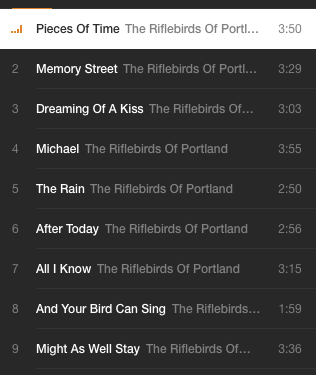
April opens with that CMJ-worthy single. It floats in on the ether like a Sandy Denny song sung by the Bangles’ Vicki Peterson, while the lyrics delve into the shifting sands of time. “Memory Street,” written by Etzioni, explores a bittersweet truth that the brokenhearted face, both damning and rejoicing in what they had. The Oser-penned “Dreaming of a Kiss” sounds like a lost treasure/outtake from the Bangles’ stellar debut, All Over the Place—high praise, I should add. “Michael” and “The Rain,” both written by Oser, are gems; the former features a plaintive piano that reminds me an Elton John song, while the latter features a lilting vocal from Lieuallen and an emotive fiddle solo courtesy of Skip Parente. “After Today,” a joint Oser-Etzioni effort, is another Bangles-esque track, featuring a bouncy bass and, as played by Doug Weiselman and Scott Schuerman, bright brass. The plaintive “All I Know” finds Lieuallen showcasing her upper register to nice effect, while the band’s rendition of the Beatles’ “And Your Bird Can Sing” is sure to have you singing along. “Might as Well Stay,” another Oser-Etzioni collaboration, closes the album on a nice note.
Let me end with this: I managed a new-fangled CD store in 1989 and—as I was during my college days—knee-deep into folk and folk-rock; I saw the Indigo Girls three times that summer and fall, for example, and rejoiced in introducing customers to my favorite sounds via the in-house stereo system. (The best part of what was a low-paying job.) I would have given much play to April. As Stevens observes in “The Pure Good of Theory”: “Time is the hooded enemy,/The inimical music, the enchanted space/In which the enchanted preludes have their place.” April is just that: an enchanted prelude. It reminds me of a time when I was long pre- my sell-by date.
 The Old Grey Cat