I glance over my shoulder when backing up. Sounds strange, I suppose, but understand: my Mazda3 Time Machine comes with a backup camera that shows, on the infotainment screen, a wide-angle view of everything behind the car the moment I shift into reverse. If danger—be it car, pedestrian or even squirrel—presents itself, a beep-beep-beep blasts from the speakers and DANGER WILL ROBINSON flashes at the bottom of the screen. (Well, maybe not the Will Robinson part.) There’s no need to twist in the seat and look out the back window, yet muscle memory is muscle memory.
Old habits are hard to break, in other words. Old sounds, too. Of late, in the car, I’m as likely to tune in one of SiriusXM’s nostalgia-soaked channels as I am something new via Apple CarPlay. A metaphoric beep-beep-beep blasts when I turn on the ‘80s channel, however. For those who haven’t heard it: It’s mostly a mix of the era’s MTV fodder and AOR rock, aka the kind of stuff many of us tried to avoid back in the day but heard, anyway. Frat parties, restaurants/bars, and other people’s cars: There was no escaping the bland and boring. One result: Much of what I abhorred now ignites pleasant memories of fun times with friends. And the music that I loved? It rings like a church bell on the hour, loud but never jarring, always comforting.
It’s the gift and curse of growing older, am I right? We hear new music through the prism of the old, and the old filtered through recollections. Suddenly, last summer morphs into last century and, hand to God, we’re left questioning, “Where have all the good times gone?” (So tell me….) April 1985, as I remember it, was one of those good times despite me often working full-time hours (for part-time pay) at a mall-based department store while living the commuter-college life. I never minded, however, because the job came with a plus: heading to Friday’s for an hour lunch or dinner (or, when I pulled an iron, sometimes both!) with coworkers/friends, downing strawberry daiquiris alongside our meals, then stopping in Listening Booth before returning to work. It was just such a Saturday—April 20, 1985, according to my desk diary—when I stumbled upon the Long Ryders’ debut album, Native Sons. (I’d read about it in Rolling Stone months earlier, but didn’t take the plunge until that day.) Forty-one years later and it’s still an album I return to—not as often as State of Our Union, which was released that fall, but it’s never not been in the mix. For those unfamiliar with their nascent alt.country/Americana sound, they basically blended country rock and punk—think the Byrds and Buffalo Springfield with a dash of the Clash mixed in.
The Long Ryders have a decades-in-the-making backstory, of course, that begins with record parties in L.A.’s Paisley Underground and ends with a breakup, other projects, reunions, re-releases and box sets, all of which are worthwhile additions to one’s collection. (That Metallic B.O., a 1989 cassette-only compilation of outtakes and eccentricities has yet to be afforded the same box-set largess as their three studio albums is a crime against deodorant. Just sayin’.) Wikipedia does a good job summarizing it all.
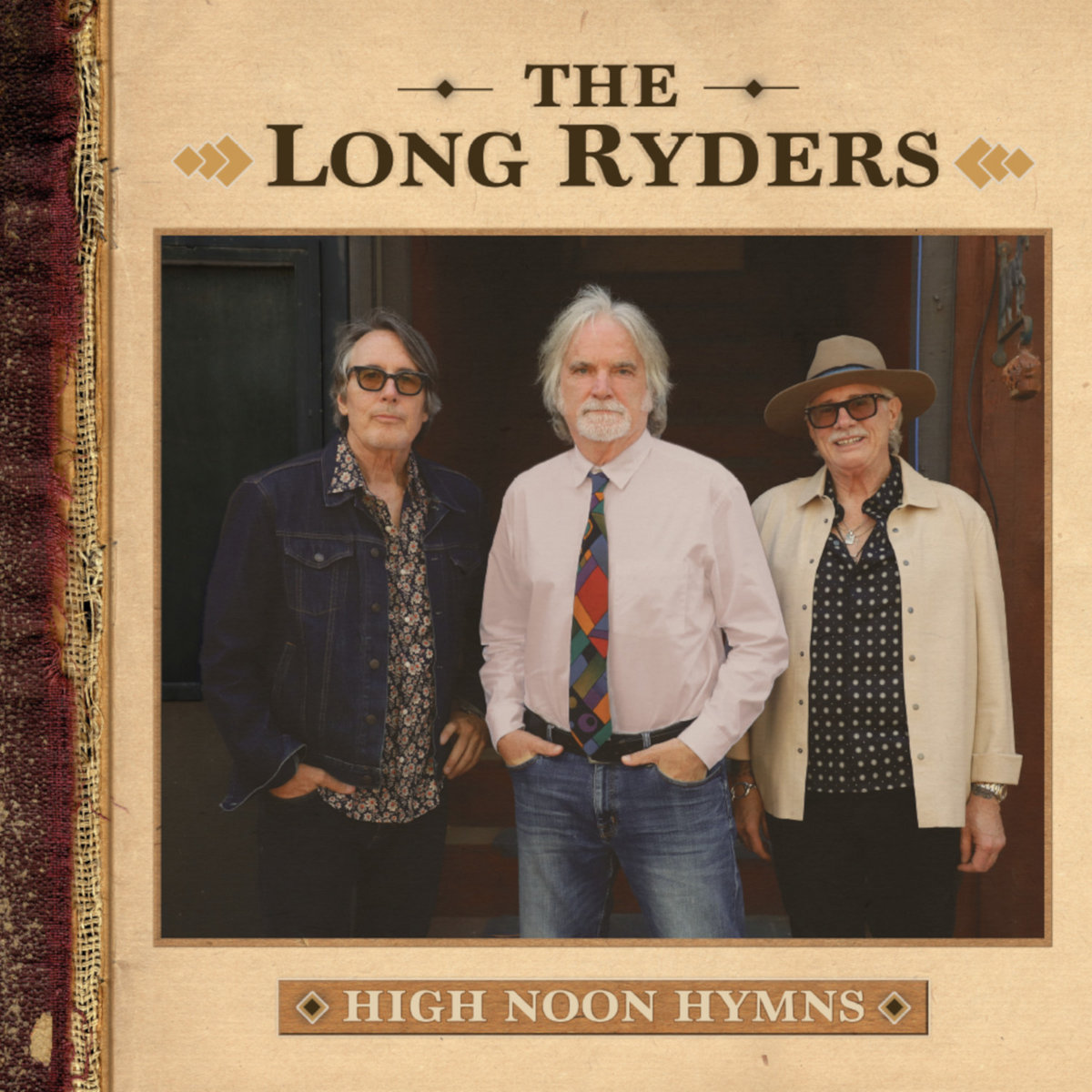
In 2019, the band—guitarist Sid Griffin, guitarist Stephen McCarthy, drummer Greg Sowders and bassist Tom Stevens—released an album of all-new material, Psychedelic Country Soul, their first since 1987. Stevens, sadly, passed away in early 2021, but the others continued on with September November in 2023 and, now, High Noon Hymns. (Murry Hammond of the Old 97’s helps fill the rhythmic gaps left by Stevens.) As with their previous “reunited ‘cause it feels so good” releases, it’s difficult for me to listen to without hearing echoes of long ago—not just theirs, but mine.
That said, the 13-song set sounds more like Chris Hillman’s Desert Rose Band than the Byrds to my ears. (That’s not a dis, by the way. I still wear my 35-year-old Desert Rose Band T-shirt!) Too, as with their past “reunion” outings, the punk quotient has been traded for a country-rock feel. (Understandable, as punk’s a young man’s game.) It opens with Griffin’s “Four Winters Away,” a toast to the future that somehow conjures days long ago. McCarthy’s “World Without Fear,” which follows, is a prayer set to song: “The fortune teller just had this to say/try to show some kindness today.” The charged “Stand a Little Further to the Fire,” written by Griffin, is anchored by a T.Rex-like guitar riff and accented, near the end, by a Johnnie Johnson-esque keyboard turn from producer Ed Stasium, while McCarthy’s “Ramona” breezes from the speaker like a long-lost Flying Burrito Brothers to outtake circa the Rick Roberts years; the former references the “liar in chief” (aka the tinpot despot) while the latter delves into said liar’s inhumane immigration tactics.
The album is not one political broadside after another, however fun that may have been for some of us. Griffin’s rollicking “(How, How, How) How Do You Want to Be Loved” celebrates a long-lasting love: “I know we’re not as young as we used to be/but now more than ever you’re the world to me.” “Knoxville on the Line,” written by McCarthy, is a moving memory that’s equal measures Gram Parson’s “Hickory Wind” and Dwight Yoakam’s “Miner’s Prayer.” Griffin steps to the fore again with “A Hymn for the City of Angels,” a tribute to the town that took him and millions of other transplants in. “Down to the Well,” a Sowders-McCarthy cowrite, ups the tempo a tad, with its gritty guitars underpinning lyrics about the divides that separate us.
McCarthy’s “Wanted Man in Arkansas” would’ve been covered by Johnny Cash in another era, I think. Griffin’s “A Belief in Birds,” is a birder’s delight that hides a dark truth: “Sometimes I wish that I was happy/Sometimes I wish I could be so gay/If I could fly/I’d fly away….”
“Rain in Your Eyes” is another Burrito-like missive from McCarthy that recalls a love gone wrong not with malice, but understanding. Griffin’s “Say Goodbye to Crying” encourages a downbeat someone to swap self-pity for self-love: “You got tomorrow and you’ve got today/You got something you got to say/You can’t make money, you can make a friend/take my advice, now we’re at the end….” The album closes with a rendition of Bob Dylan’s “Forever Young” that features a mandolin solo from bluegrass wunderkind Wyatt Ellis; a few reviews I’ve read have called it mawkish and ill-advised, but I like it. It resonates in the best of ways.
So, to return to the top, I glance over my shoulder when backing up. It’s long-ingrained second nature. I flashback to the days that used to be via SiriusXM while driving down the familiar-yet-unfamiliar roads of the place I now call home. These last few weeks, however, I’ve flipped from the radio to High Noon Hymns. In some respects, the album’s akin to catching up with an old friend. Such reunions inevitably revisit the past, of course, but at their best they also feature talk of today and tomorrow, of our joys and sorrows. Such is the case here.


One thought