To borrow an observation from philosopher-scientist Walter Bishop, “Music helps you shift perspective, to see things differently if you need to.” Perhaps no better music to fuel leaps in logic exists than improvisational jazz, which—at its best—knocks on and then kicks in the doors of perception. In a way, and to shift metaphors, it’s a bit like an expert electrician swapping out corroded wires for new copper lines in a century-old house. Suddenly, the dim and musty attic packed with boxes of dormant memories and thoughts is awash in light.
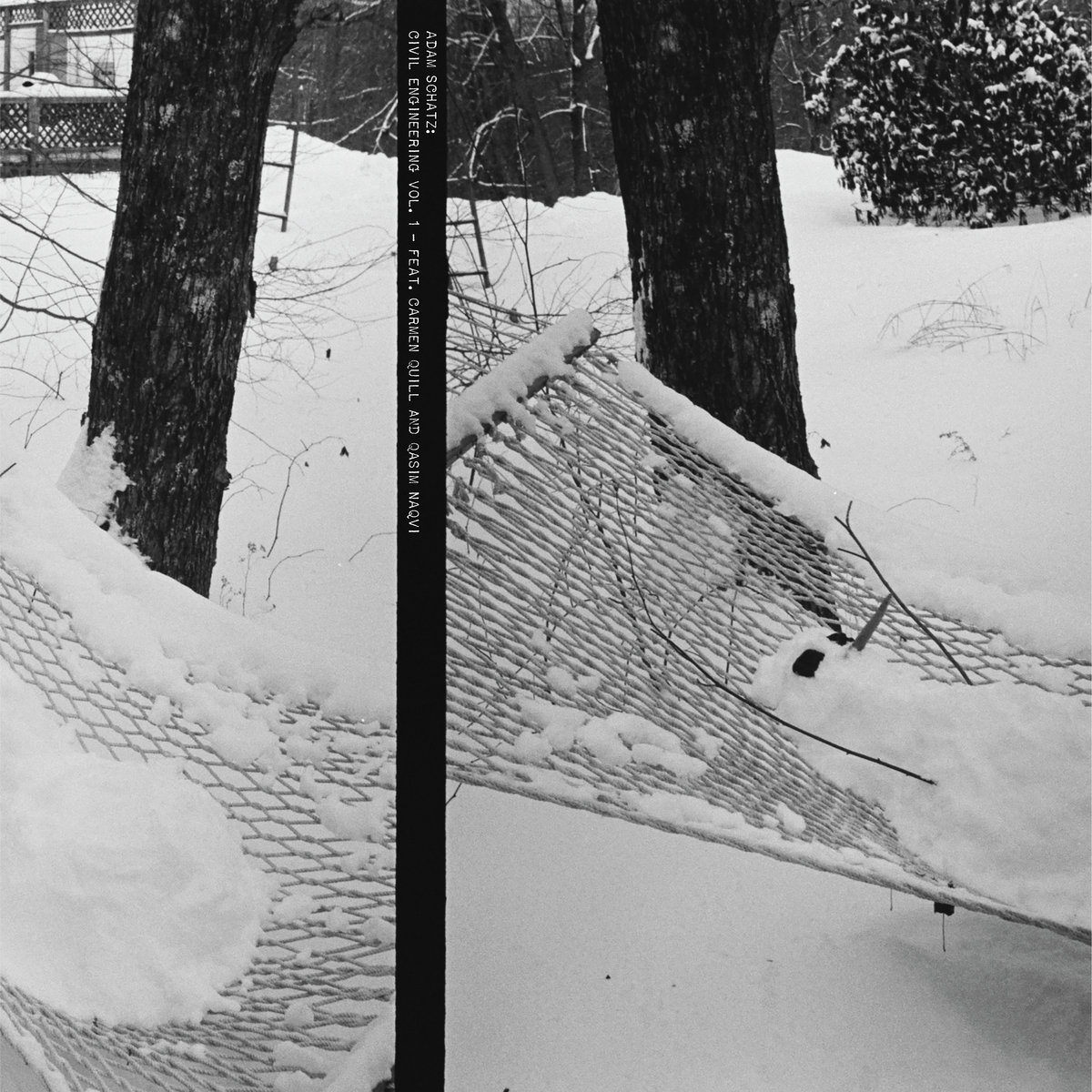
Multi-instrumentalist Adam Schatz’s Civil Engineering Vol. 1 is just that. It’s an intoxicating dose of high-octane yet low-key jazz that’s simultaneously avant-garde and old school—and the product of an unexpected opportunity: in-house Power Station engineer Seth Paris needed to teach younger cohorts how to use a Studer tape machine. As Schatz relates in the press release, “I smelled an easy excuse to make some spontaneous magic.” He called upon friends Carmen Quill (bass) and Qasim Naqvi (drums), both of whom agreed to take part in the project. “I’d arrived early to setup and plug in devices, assemble my saxophone, affix a contact microphone onto the soundboard of the grand piano allowing me to delay, loop and manipulate the instrument in real time. Carmen arrived and we started making some initial noise for the demonstration Seth was leading behind the glass, and by the time Qasim walked in we were already improvising. He sat down and what happened next is what you hear on the record.”
The lead-off track, “A Test of Attention Spans and Contact Cleaner,” delves into the friction between melody and rhythm, not to mention details and the whole, with his tenor sax stepping to the fore only to be replaced by a minimal—and beautiful—piano motif. It plays out, in some respect, as if a succession of thoughts just beyond one’s grasp.
“A Border Between the Lands of the Living and Leaving,” which features just Schatz and Quill, navigates the border region between reality and dreams in mesmerizing fashion, crystal clear one moment and blurry the next. “A Voice Screaming All Aboard” steps onto the platform of a fevered mind—you know the kind, when dozens of thoughts stream past way too fast while our internal conductor attempts to tame them. “A Growing Line at the Return Counter” ushers in a sense of calm. The 21-minute “A Pox on Your Upstairs Neighbors” should appeal to those who, at one time or another, dealt with unwanted noise from either above, below or beside their home; it plays out much as those unruly neighbors, somewhat quiet at evening’s start only to up the volume as the night wears on. The interplay between Schatz’s piano, Quill’s bass and Naqvi’s drums is a delight, with the tension rising and subsiding again and again. The album closes with “A Rock Solid Reply,” which is accented by some cool interplay between Quill’s bass and Schatz’s sax and synths.
I’ve enjoyed Civil Engineering Vol. 1 for several weeks now, usually playing it first thing in the morning. It’s become the audio equivalent of a cup of coffee, in a sense, with the bitterness balanced by cream and brown sugar. (Try it if you haven’t.) It’s discord buttressed by epiphany, dark with light, a sonic noir.

