I dreamt last night that Diane wanted to burn a CDR of songs for the car but couldn’t recall how. I still remember the process, I said, but was pretty sure it’s become an overly complicated endeavor that’s more frustrating than fun—and, really, why bother? The Mazda3 Time Machine came sans a CD player. Why not make a playlist instead? I know, I know: riveting stuff. Some folks dream of riches and fortune. I dream of old ways, old days, of big corporations stripping away the joys of long ago. To quote Neil Young, “I used to dig Picasso/Then the Big Tech giant came along/And turned him into wallpaper.”
Since traveling north last month, I’ve found myself immersed in memories of how things were, of cobbling together late-night soundtracks on cassette or CDR, of worrying about time length and leftover space, of kids who were children and not grown adults. It’s not a phenomenon specific to me—many people of a certain vintage find themselves lost, if not stuck, between what was and what is. As this blog has evolved, for instance, I’ve found myself leaning forward more often than not, searching for and celebrating new sounds, new artists, new this, new that. It’s simultaneously overwhelming and joyful—I’m forever astonished by just how much good music is being released—and, yet, I feel like I’m still missing something. What of cherished singers, songs and guitarists that long to be listened to again? To borrow a few lines from the poet A.E. Stallings:
The sappy retro soundtrack of your youth
Ambushes you sometimes in a cafe
At this almost-safe distance, and you weep, or nearly weep,
For all you knew of beauty, or of truth.
For me, it’s not so much a cafe but a grocery store, with such stops requiring earplugs if one wishes to skip the scores of youthful follies raining from the ceiling. It’s strange, right? Music and memories mix and match, mingle together, morph into something majestic one moment and imbecilic the next—and, every so often, both at once. Such was the case on a freezing December day in 1989, when several inches of snow in the early afternoon iced over during the 20-degree night. It was best to stay off the roads, the news—and my dad—warned. “Are you crazy?” he exclaimed. (Yeah, I still lived at home. Deal with it.)
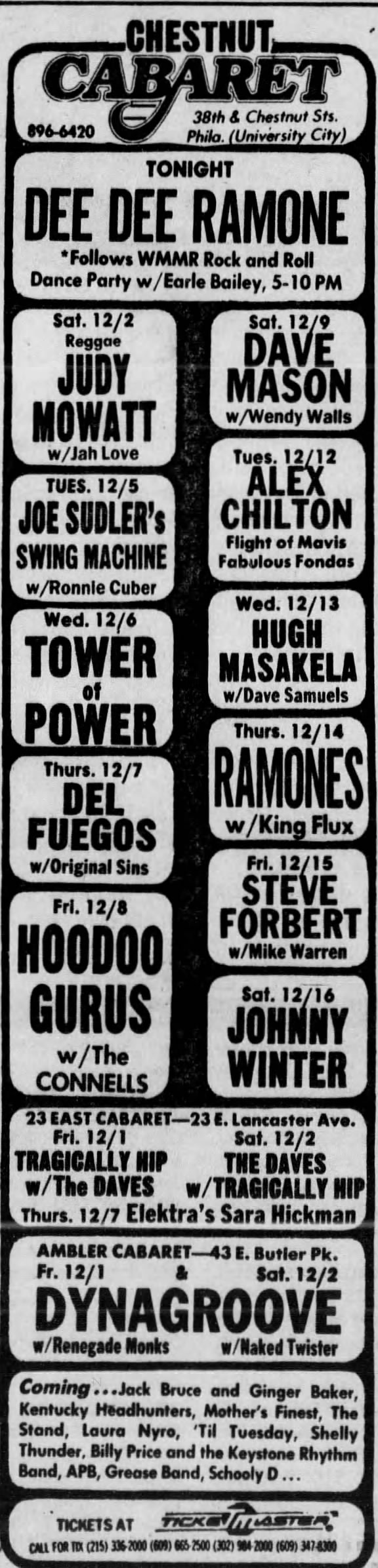
I paid him no mind: Diane and I had tickets to see Alex Chilton at the Chestnut Cabaret—a guaranteed late night, given that two local bands were booked to play before the Big Star eccentric hit the stage, with the whole shebang not slated to start until 9pm. I was, what? 24? Foolish? Foolhardy? Both? Driving an hour-plus from the northern ‘burbs to Bala Cynwyd, where Diane lived, and then on to West Philly, all in a rust bucket with balding tires, wasn’t smart. Black ice was everywhere, or so the KYW-1060 newscasters claimed, but I experienced no issues. The same couldn’t be said of other concert-goers, unfortunately. I don’t know how many shelled over the $10 entry fee ahead of time, but the venue, which could fit about 800 bodies, was a sea of empty space—whether from a lack of interest in Chilton or the bad weather, I can’t say.
This post isn’t about Chilton, of course, but one of the two supporting bands on the bill, and I don’t mean the Fabulous Fondas. I remember Diane and I biding our time at a table along one of the Cabaret’s raised sides, me—since I still drank—likely nursing a beer. I have no memory of the Fondas, who were a well-regarded Philly band. Flight of Mavis, on the other hand—it took seconds for me to recognize the guitar slinger at the main mic as a former high-school classmate, Frank Brown. (I didn’t realize it then, but I also kinda-sorta knew the other two Mavis members, bassist Dave McElroy and drummer Ken Buono, from school.) In middle school, at the same assembly that premiered a silly short film I made with friends in cartooning class, he and his band rocked the house. They did the same this night; as I noted in a long-ago piece, when my memory was far more fresh, they “achieved something few opening acts in Philly succeed at: They captured the audience’s attention and affection, whipping out tasty concoctions that served up equal parts feedback and catchy melodies.” Why they or Buzz Zeemer (essentially Flight of Mavis with Philly rock legend Tommy Conwell) never broke through to national acclaim remains one of the music world’s biggest mysteries.
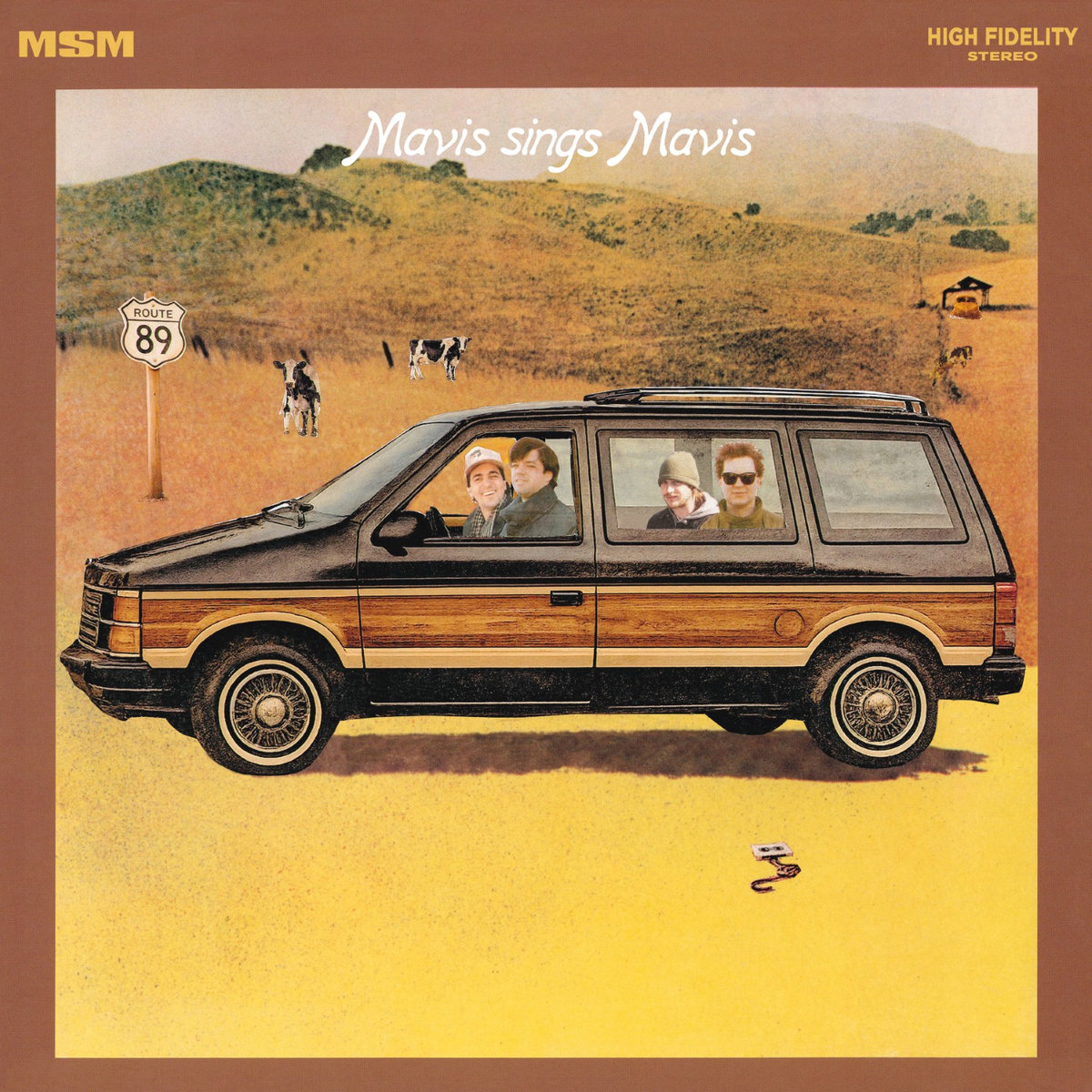
Anyway, the Bandcamp description for Mavis Sings Mavis reads thus: “Flight of Mavis return for their first album since 1989, Mavis Sings Mavis. Recorded with longtime friend Matty Muir at historic Philadelphia recording studio Retro City Studios, the original trio of guitarist/songwriter Frank Brown, drummer Ken Buono, and bassist Dave McElroy are joined by multi-instrumentalist John Cunningham. Mavis Sings Mavis is a mix of new material and archival songs Brown wrote growing up on the mean streets of Horsham.”
“The mean streets of Horsham” rings true to this Hatboro semi-native, I must say. (The two Philly ‘burbs bordered each other and shared schools via the Hatboro-Horsham School District.) To me, who moved to the region at age 10, it was a giant green ocean of banality, while the more compact Hatboro was akin to a cement fish tank that I couldn’t wait to break out of—and then, at a certain juncture, longed to return to.
I’m getting far afield, I realize, from the purported purpose of this piece: my “first impressions” of the nine-song, 30-minute Mavis Sings Mavis. But isn’t that what good/great music does? It takes us hither and yon, memories spring-boarding from melodies and sentiments spiraling out from guitar solos, until you’re lost in moments past, present and even future. The opening “Holding Me Back,” for instance, digs into the unnamed things that constrain us; it’s life in a nutshell, really, balancing wants with needs. “Gotta Get New Car,” driven by a Bo Diddley beat, is a rollicking good time that anyone who grew up (or lives in) the ‘burbs will identify with. “Insane,” for its part, is a wistful yet jangly ode to a fleeting meeting of the eyes, while “Garage Sale Junk” is an uptempo take on the de rigueur staple of suburban life, when families try pawn off their amassed crap. “I Need You,” one of the album’s best songs, is a mid-tempo gem about unrequited love; it’s a slower-take remake of a song that appeared on the first Flight of Mavis album in 1989.
Pretty much every music fan will hear themselves in “Tonight’s the Night,” about the anticipation that builds and builds before seeing your favorite artist or band in concert. (In Brown’s case, that means NRBQ, but it sums up me before last month’s Springsteen show.) The lowkey “Any Other Way” delves into the days that used to be, when our parents couldn’t quite grasp our dreams—and, yet, the lack of understanding didn’t much matter. The potent “Down in the Basement” ratchets up the drama with a tale about guns, security checks, and “yeah, yeah, yeahs.” Album closer “It All Comes Around,” meanwhile, is another jangly delight.
Memories and music, music and memories: Anyone of a certain age, or even younger, will hear aspects of their life experiences throughout Mavis Sings Mavis. It artfully achieves what A.E. Stalling mentioned in those lines about the soundtrack of youth—but sans the sappiness. It’s a jangly good time that delves into beauty, truth, and the desire for a sporty new car. What’s not to like?


Frank has made some of my favorite music. I think I “discovered” Buzz Zeemer when my home page on my phone had an article Lost and Found. I think I found your site by searching for more info about the band. The songs are so good, so sweet they almost hurt. I am so glad I found them, yet it hurts me that more people don’t know them. The hooks are just so good.
LikeLiked by 1 person