Life’s clock doesn’t unwind. Its hands don’t turn back. Conception, perception and metaphor aside, time ticks forward at a consistent rate—at least, it does for those of us bound to Earth. In point of fact, humankind’s adventures in space (and playtime with physics) show that time is not as constant as we laymen tend to think. It moves faster or slower depending upon a myriad of factors, including gravity and speed; it’s why the International Space Station astronauts age at a slightly slower rate. But there’s also this: quantum physics posits that time is not a flowing river but, rather, a tumultuous ocean. Time, in that construct, is essentially crowdsourced from billions upon trillions upon quadrillions of Plancks, aka the theorized smallest time unit. Some of them tick one way, some another. Whichever way the majority goes, so goes time.
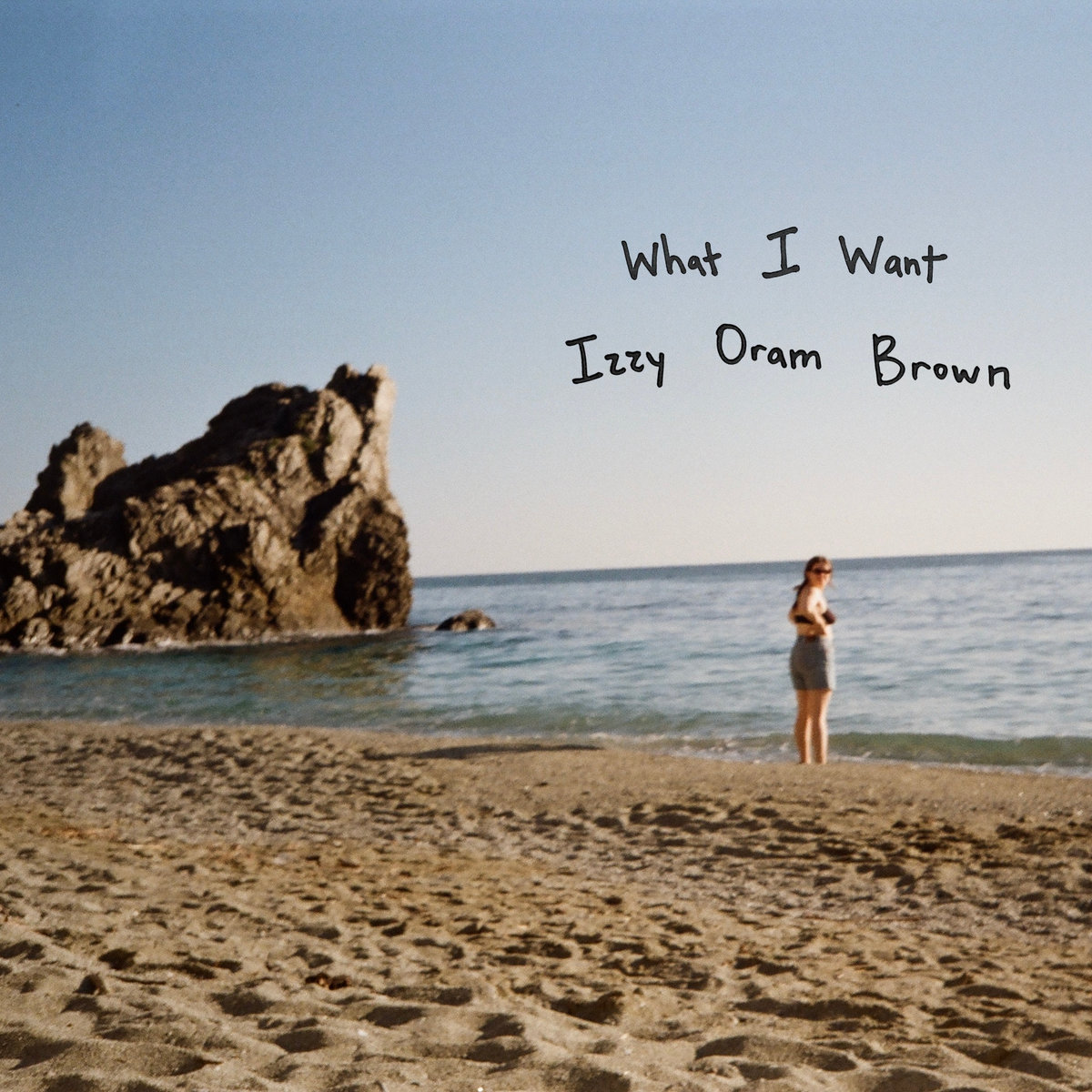
Sounds strange, am I right? Time doesn’t stop, reverse or slide sideways—but, as evidenced by Izzy Oram Brown’s shimmering sophomore set What I Want, it does double back. When I first clicked play on it a few months ago, at least, I found myself drifting through memory to the mid-1980s and beyond, when a slew of up-and-coming singer-songwriters turned my ears. Brown, like many of them, embraces an expansive folk ethos, one that dares to integrate discord, synths and drums. Her vocals, meanwhile, are akin to the morning mist on a hazy day, the dew almost imperceptible until one steps inside and realizes it’s seeped into the heart. It’s stormy and peaceful, emotive and dispassionate, aptly conveying lyrics that explore more than the norm. These are existential odes that resonate deep within the soul.
The opening “What I Want” lays out her hopes and dreams following the end of a relationship, while “Got Me Down” opens as if an introvert’s lament (“I am never more afraid/Than when I open my mouth”) but quickly reveals itself to be about someone gripped by doubt. It features a guitar solo that all but passes through you, so—yeah. It’s a remarkable song. “What Is Wanting Worth,” the next track, expands upon the theme in poetic fashion:
Gather up all my shortcomings in the palm of my hand
Take them in my fingertips and crush them like sand
Throw them over my shoulder, leave them to the wind
It’s the end, it’s the middle, it’s where I begin
As with the song that follows, “Go On,” it’s a moody bon mot, the kind of track that captures the stasis that we often wallow in post-breakup. “If I’m Not Made for Love” features a whine both literal and figurative, with Brown’s self-pity on full display: “Though Earth keeps spinning ‘round/Love is nowhere to be found.” (Quick reminder: Just because she sings “I” does not mean the songs are drawn from her day-to-day life. Although the album plays as if self-analysis set to song, she’s not necessarily the one on the therapist’s couch.)
“When There’s Nothing Left” is a dramatic dispatch that yearns and burns but never explodes; she sings of broken trust and, as if a mantra, asks ”what have I done” again and again. Here’s hoping that she brings a band with her when/if she tours ‘cause, truly, it’s sure to be incendiary in a live setting. The delicate “I Don’t Mind,” which follows, reins in the loathing for acceptance: She is where she is, and is fine biding her time until life catches up with her. “Love U the Same” revisits the reason for the emotional tumult, while moving past it with empathy for both herself and the other. The closing “I Believe” echoes the ages, just about, while sharing the crux of this thing we call humanity: “But I believe in the in between/And I believe in the starting clean/Well if that makes me wrong/So let it be, let it be, let it be.”
Brown, who’s worked as both a session and touring guitarist for others, co-produced the album with Jesse Bielenberg; the two of them played the bulk of the instruments, though Connor Parks handles drums on seven of the nine tracks and Sam Talmadge plays guitar on “I’m Not Made for Love.” Overall, it’s a jaw-dropping album, the kind you play again immediately upon its end. I hear hints of Suzanne Vega and Lucinda Williams amongst many others, while Elliot Smith’s influence is also evident.
What I Want may not stop life’s clock, but it does pull the fabric of spacetime into a taut and oddly comforting hammock; the aged and young alike will glean insights into the messy essence of this thing called life. Plus, on a more practical level (and to borrow from my own cliche), Brown’s songs take you there, wherever there is. It’s a great album.


One thought