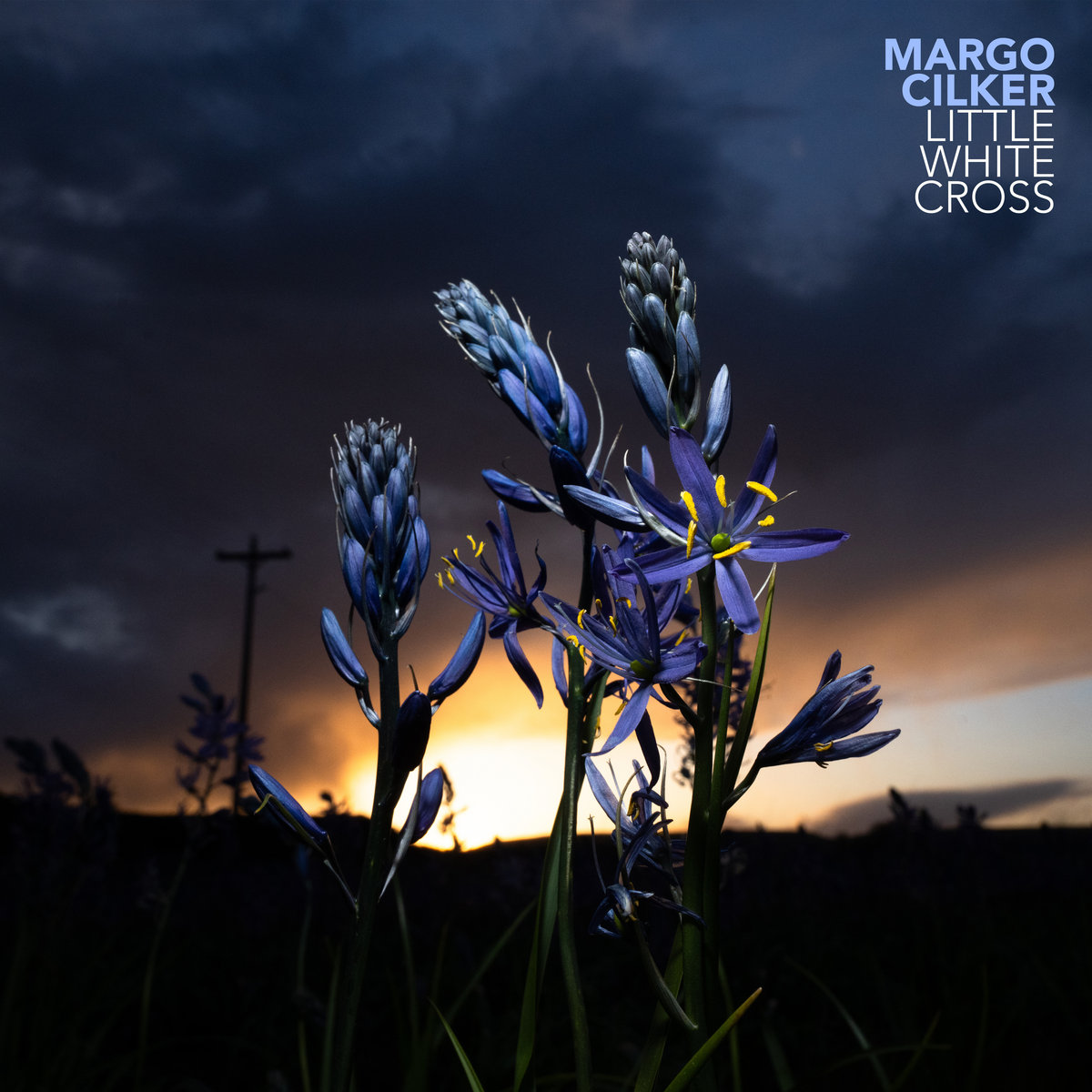
Sell-by dates have been on my mind, of late. Am I past mine? Should I take myself off the shelf? Much of the music I spotlight emanates from artists young enough to be my children if not grandchildren; though most experiences—heartache, heartbreak, and the like—transcend the generations, the modern and post-modern accoutrements that accent many of them have become, at times, unrecognizable to me.
Perhaps that’s why Margo Cilker’s Little White Cross resonates deep in my soul. It delves into the commonalities and complexities of life that we all recognize if not share. “Some days are diamonds, some days are rust,” she sings on “Walls,” a taut cover of the Tom Petty tune—the line sums up the album, in a way. It tackles loss, tragedy, and escape, the fleeting grace we all seek but rarely find. It’s heartfelt and poetic, yet journalistic, with such songs as “Molly and Me”—about the sister of a mass shooter—conjuring Nebraska-era Bruce Springsteen.
The 10-track set opens with “Little White Cross,” written by her friend Christy Walls, about the senseless deaths that surround all of us: “Little white cross on the side of the road/Little fake flower and a crown of gold/They were going so fast, how were they to know/They’d be a little white cross on the side of the road.” Cilker’s vocal tone and delivery, as they have since first I heard her, remind me of a young Lucinda’s. It’s the first of six outside songs that Cilker makes her own, with the second, Sera Cahoone’s “Ladybug,” maintaining the melancholic mood; it shares a sentiment too many face in the aftermath of a tragedy, in this case the murder of her cousin by the cousin’s partner: “All the signs were right there, we just couldn’t see/All the signs were right there, we just couldn’t believe.” As with the album as a whole, it’s country-tinged folk with an Americana twang, a song that resonates for a simple reason. The signs are almost always there, to be seen, but our willful naïveté blinds us to them.
“Molly and Me” is an evocative portrait not just of an innocent bystander, but of the family lives some are too ashamed or embarrassed to share: “Molly never mentioned the trouble at home/It’s just not the kind of thing she would show.” “State Line,” another original, ups the electric current while sharing the saga of a star-crossed love: “I know loving me took some abandon/An engagement outside of God’s plan.” “Walls” maintains the electric mood, adding massive drums as accents and umlauts to the goings-on. “Pauline” returns to the journalistic imprint of “Molly and Me,” this time sharing the story of a woman lost to a drug overdose.
A cover of Ian Tyson’s “Road to Las Cruces,” which she performed when I saw her in 2023, follows; it’s a bittersweet ballad about how past loves linger long in memory. Kevin Carducci’s “The Money,” on the other hand, delves into the corruption that comes with the almighty dollar. The touching “Maryhill Peaches, Goodnoe Pairs,” which Cilker wrote with her husband (and bandmate) Forrest VanTuyl, chronicles the realities that farming families face—and includes a line that’s haunted me since I first heard it: “It takes time to fix something you never thought could break.” The album closes with a riveting cover of “Wolves” by Stephanie Davis, which was first sung by Garth Brooks in 1990; it tackles the far-too-cyclical financial crises faced by farmers, with the wolves that threaten livestock becoming synonymous with the banks that threaten foreclosure.
Produced with Bruce Robison at the Bunker in Lockhart, Texas, the album features support from Geoff Queen (guitars), Lisa Pankratz (drums), Scott Davis (bass), Emily Gimble (piano), and VanTuyl (organ), plus Josh Blue (percussion), Beth Chrisman (fiddle), Sarah Cilker (backing vocals), and the great Eric Heywood (pedal steel). Not a note is wasted.
I have lived with Little White Cross for more than a month. It hits the same now as it did on that first listen, with its smart mix of originals and covers coalescing into a whole that’s larger than its parts—and those parts are, to a one, moving testaments. It’s a country-tinged Nebraska, grim and bleak, an artful catharsis.

