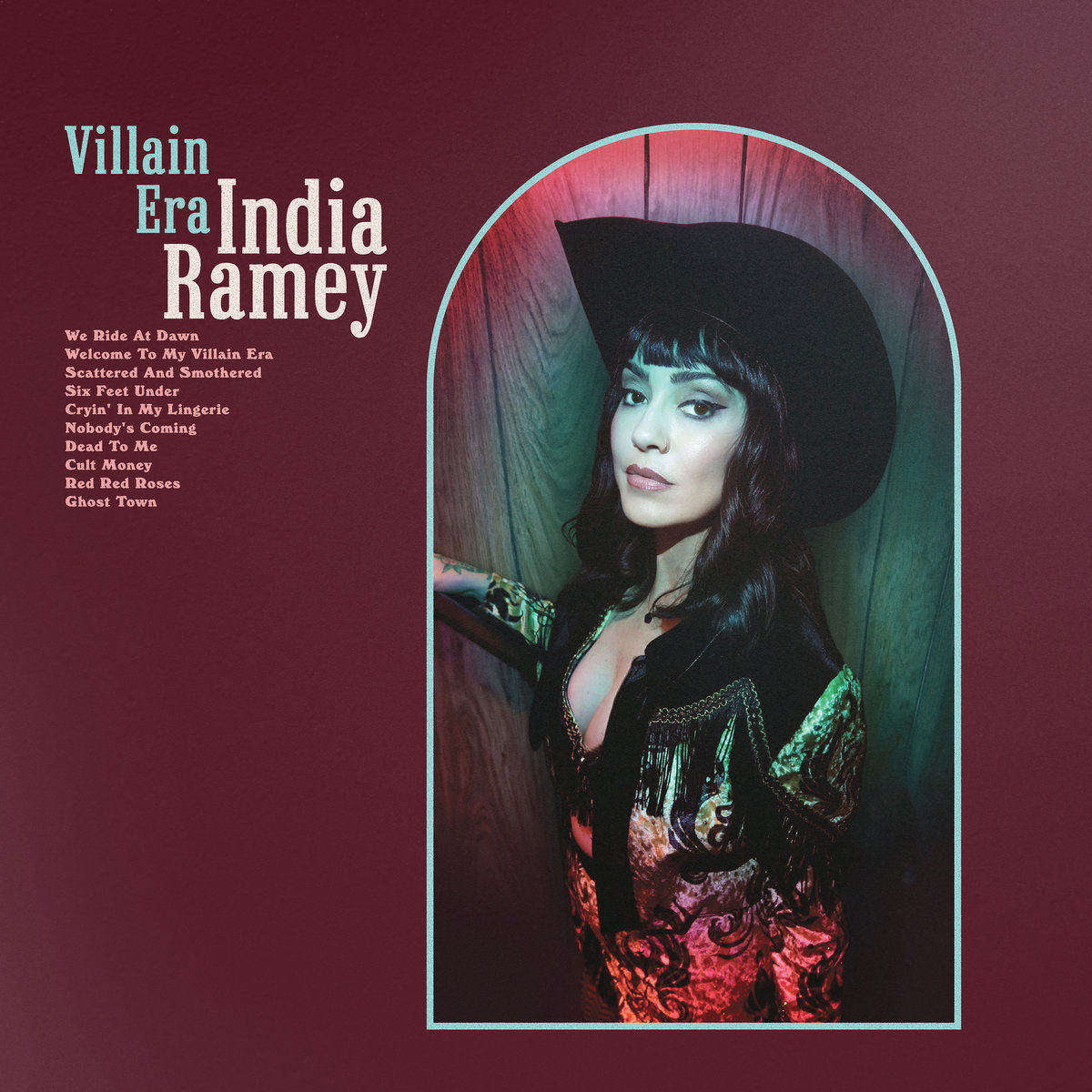
Some call her the “Woman in Black,” others the “Wednesday Addams of country music.” The first makes sense, the second…well, I prefer thinking of her as the Abby Carmichael instead. As Law & Order fans can attest, that no-nonsense ADA’s quest for bloodlust justice occasionally surprised her boss, Jack McCoy—who, it should be noted, was no slouch himself. To that end, Ramey sings in the lead-off track on her sixth album, Villain Era, about seeking vengeance on a band of marauders who decimated her town: “They feared not God, nor man or the Devil/Hell hath no fury like a woman scorned/We’ll have the wind and the spirits of/Our mothers at our backs/There are no bygones/We ride at dawn.”
The one-time prosecutor, who overcame a hardscrabble childhood, specialized in domestic-abuse cases before moving to Nashville to pursue her music dreams. Villain Era, her sixth long player, features a CinemaScope-worthy score that will conjure Quentin Tarantino films for some and Sergio Leone movies for others—it depends on one’s age, I think. Either/or, at album’s start, she casts herself as a lone figure on horseback traversing the desert haze, cowboy hat pulled to her eyes, compelled to defend the downtrodden.
She’s not afraid to be perceived as the baddie—or to be confused for “Alice Cooper in a little black dress.” She’s got a wicked sense of humor, in other words, that pairs well with the pathos she mines from life. “Six Feet Under,” for instance, finds her vowing to avenge her heartbreak from the grave, while “Cryin’ in My Lingerie” jousts with self-pity, cliches, and the possibility of ending up a divorcee. Other songs, such as “Scattered and Smothered” and “Cult Money,” conjure Jeannie C. Riley circa “Harper Valley PTA” (albeit updated with 21st-century sensibilities), while others—most notably “Red Red Roses”—find her channeling her inner Loretta Lynn.
“Nobody’s Coming” employs the smart metaphor of quicksand to depict her battle with PTSD-related depression, which is a fight that one ultimately undertakes alone: “Nobody’s coming/No matter how loud I scream/Nobody’s coming/My salvation’s up to me.” The closing “Ghost Town,” meanwhile, examines a downturn of another kind: the disappearance of original country music from Lower Broadway in Nashville, where such legends as Patsy Cline and Willie Nelson got their start: “There used to be cowboys here/They told tales that would bring you to tears/And the women all sang/With that sacred twang.”
Unlike so many modern country outings, Ramey wrote all the songs herself. She recorded them in L.A. with producer Eric Corne; the supporting cast includes Eugene Edwards (Dwight Yoakam) and Chris Masterson (Wallflowers) on guitar; Ted Russell Kamp (Shooter Jennings) on bass; Bob “Boo” Bernstein on pedal steel; and Eleanor Whitmore (Steve Earle) on fiddle. It’s a moody set, to be sure, but one that’s ultimately uplifting and enthralling. Recommended.

