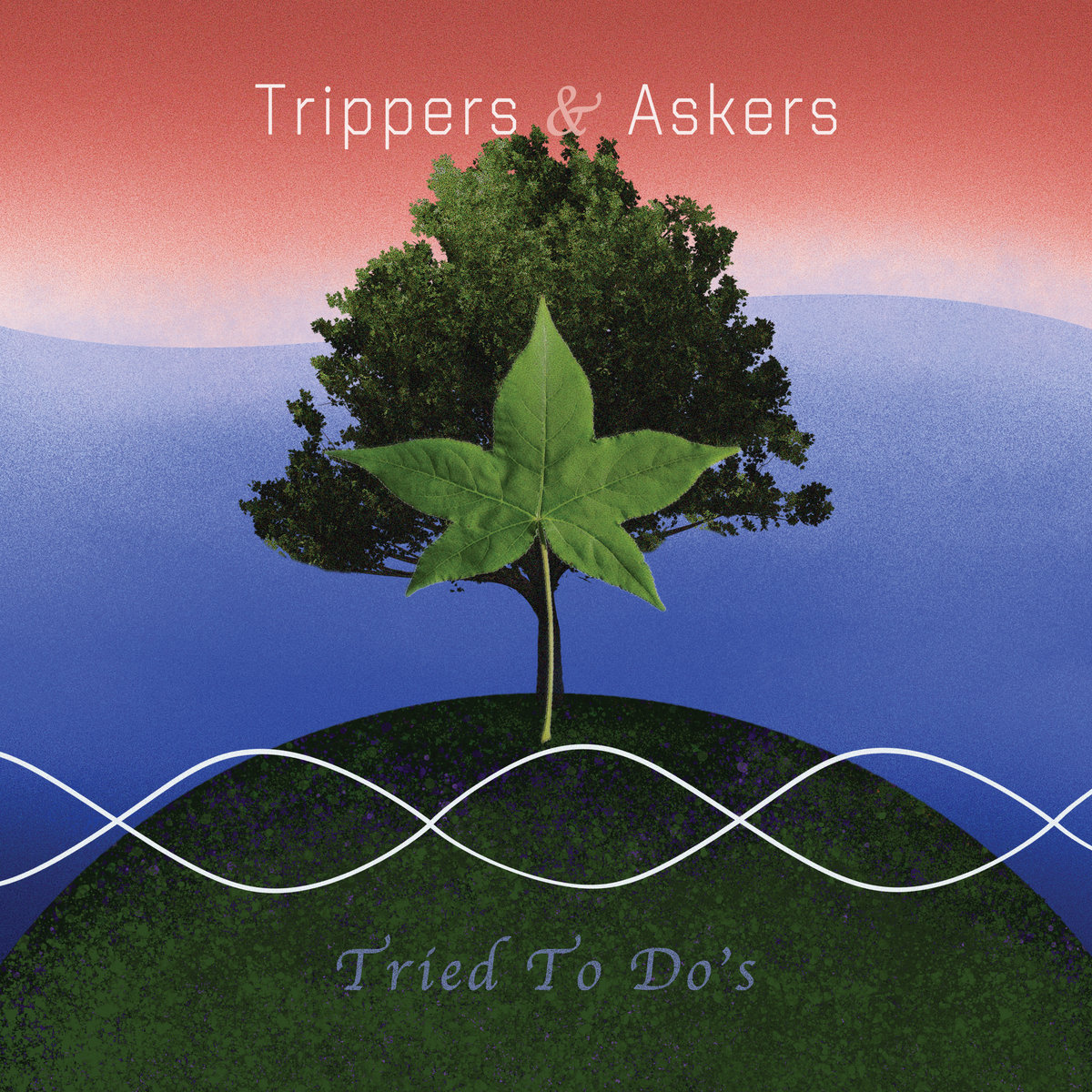
Grief is a multi-faceted beast that shifts shapes and colors, hides in plain sight. Much like the winged serpent Typhon of Ancient Greek myth, it can spur ocean waves that crest, crash, and push inland, overwhelming everything in their path. Seawalls and sandbags matter not in such instances, while the extent of the damage can’t be discerned until the water recedes—and, as importantly, the serpent slithers away.
Everyone mourns at some point, of course. By the time we reach middle age, if not before, most have lost someone close, be it a grandparent or parent, sibling or friend, spouse or child. Some ride the waves of despair. Others plunge beneath them. At a certain point, however, one arrives on dry land, wet but able to walk. The folky Tried to Do’s by Jay Hammond, aka Trippers & Askers, is a stirring collection that processes such loss and heartbreak through the lens of both Buddhist and Christian lenses.
The “New Churchyard,” a short instrumental, flows into a spellbinding meditation on impermanence, “No Comings, No Goings,” a duet with Chessa Rich; to say that it lingers in the soul is an understatement. “Closeness” explores what, for some, is the most frightening aspect of life: “Closeness is a frightening gift/A heavy love that you’re not sure you can lift.” To commit to another is to risk loss—not from breakups, but worse. (To quote Benjamin Franklin, “nothing can be said to be certain, except death and taxes.”) “Seven Homecomings” delves into the role of faith in life, while “Re-membering” explores how grief is not unique to us: “We moon tent our way into/a new terrain whose paths are old/and well worn.” The moody title track ponders how we process perceived failures: “I really don’t think that life’s about the I could have been’s/I really think that life is all about the I tried to do’s.”
“Kin” plays out like one of the story songs I played on the radio way back when; as with the other tracks, Hammond’s grainy vocals lend a gravitas to his lyrics. “Waterhole,” on the other hand, posits that we possess the power to change despite the past’s impact on our present: “He is the light to his own soul/There is no one to whom he pays the toll/There’s just one face that he needs to know/The one looking back from that waterhole.” “Prologue” extends that thesis: “What does it mean to know from who you come and who you sow?/When all of your family can find a space in which to weave?/To know who is part of you, when you wish it wasn’t true?” “Trust” places faith in the self to soldier on: “I am a precious being/And I trust my knowledge/Of how to care for myself.” The album closes with “Old Churchyard,” a traditional Appalachian hymn about the how we need not mourn lost loved ones: “their trials are o’er/Why weep for those who weep no more?” (Easier said than done, of course.)
Hammond, who has a fair number of albums to his credit, has crafted a moving suite that should resonate with anyone who’s experienced loss—and even, I think, those lucky enough to escape it thus far. He may not have slain the beast, for that’s impossible, but he’s quelled it—for a time, at least. In short, Tried to Do’s is folky and soulful, questioning and calming, the kind of album that insists on a second play once it ends.

