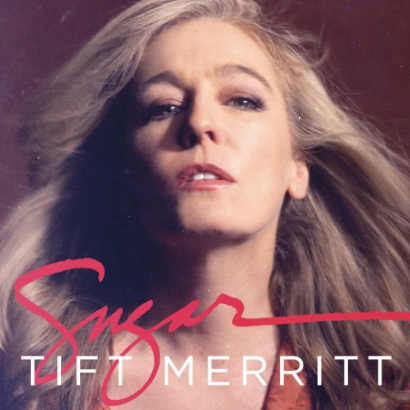
As I write, the new Tift Merritt album fills the room for the umpteenth time since Friday. Mr. Mo, our orange tabby, lies nearby, trilling along with certain songs. The marvelous Miss Maisie, his tortie sister, is elsewhere, likely scoping squirrels from the sunroom or, perhaps, napping inside the fold-out couch. (Yes, you read that last part right.) We live in unsettled times yet, on days such as this, with music such as this, everything seems okay. Better than okay. Sugar—Tift’s first studio set since Stitch of the World in 2017—is sweet and creamy, moody and dramatic, literate, even operatic in spots. “Stentorian” is how Diane described it, in part, when we played the album while out and about on Saturday.
Produced by Lawrence Rothman,the 12-song, 43-minute set was tracked live at Nashville’s Gold Pacific Studios with guitarist Audley Freed, multi-instrumentalist Robert Ellis, and Dr. Dog drummer Eric Slick, who we saw open for Tift at a magical 2017 night at the World Cafe Live in Philly. They create a sonic intoxicant that blends country, soul, and folk, while conjuring Maria McKee’s High Dive on several songs—Diane hears it in her vocals, at any rate, while I hear it in the resonant tone of the piano. (Either/or, it’s a major compliment.)
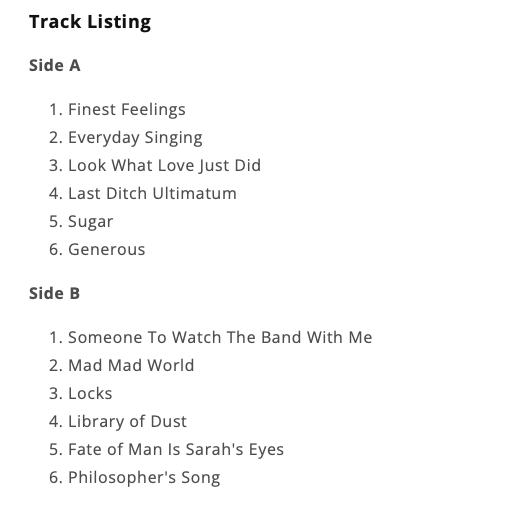
Our suspect hearing aside, the song cycle rises and falls, crests but never collapses, prances and pirouettes, pushed and pulled not by the gravitational forces of the moon but that of the soul. Playlists are fine and serve a purpose similar to radio, but to jump metaphors: Albums, at their best, are aural paintings. In this case, the initial brushstrokes—“Finest Feelings”—bristle with anticipation, hope, lust. Most of us possess a need for connection and confirmation, for recognition, for touch. The catchy “Everyday Singing” unfurls the flag of resilience in the face of personal crises: “Whatever comes next, there always will be poets and revolutionaries/People who risk their own for another, and the everyday singing of mothers and daughters/daughters and mothers.” (She left out cat dads and their kittens, but whatever.) “Look What Love Just Did” echoes her early works in the best of ways while celebrating unfettered love.
“Last Ditch Ultimatum” recedes the upbeat tempos on the tones of a somber piano, all while strings accent the proceedings. It shares a parable that some might dismiss as tripe but, really, rings true to my ears; Jesus commanded us to “love thy neighbor as thyself,” after all. Perhaps because I recently watched the episode of Patience in which the title character participates in it, but the title track could well be inspired by speed dating: “I didn’t really want to be here tonight/I don’t need you looking at me, I don’t like the light bright/Somebody’s waiting on me, I got a baby of my own/The only thing I got to shine for us back at home.” (Of course, I jest. She told Variety in an excellent interview that it’s about “reminding yourself to feel, and reminding other people to feel. To really be a messy human is really important.”)
The delicate “Generous” digs into the aftermath of a relationship; it’s half lament and half lashing out, questioning how he can move on without looking back. “Someone to Watch the Band With Me,” on the other hand, finds her yearning for someone to dance with on the floor of a dive club; it rocks, though not hard, with the reining in of raucousness upping the ache.
“Mad Mad World” casts a critical eye on “a city of forgotten people just like us/Alone in a world that doesn’t seem to care.” “Locks” finds her figuratively wiggling a bobby pin into a keyhole in hopes of rotating the cylinder and unlocking listeners’ hearts. “Library of Dust,” meanwhile, is the song that led Diane to make the connection to Maria McKee’s High Dive; it’s a dramatic, piano-driven tune that was inspired, she explained on her Nightcap blog, by photographer David Maisel’s book Library of Dust, which collects the colorful images of copper canisters that contain the unclaimed, cremated remains of Oregon State Hospital patients.
“Fate of Man in Sarah’s Eyes” turns rudimentary aspects of life into a metaphor for something more. On her Substack blog, she explained of its origin, “I had the melody, mostly, but not the narrative so I walked around the kitchen poking the question What is this song about? until I knew. The indispensable person who keeps the world turning is Sarah, a washerwoman taking in laundry, raising the sun, dispensing time, and everything else, cleaning all our souls.”
“Philosopher’s Song” is a perfect closing benediction to what is, in many respects, an album-long prayer; it’s a resonant piano tune that finds her seeking solace and answers from Mother Nature—much as Wallace Stevens did in “The Idea of Order at Key West.” It’s a remarkable end to what is a remarkable album.
(Sugar can be streamed from all the usual suspects, while the CD or LP can be purchased direct from Tift’s web store.)


One thought