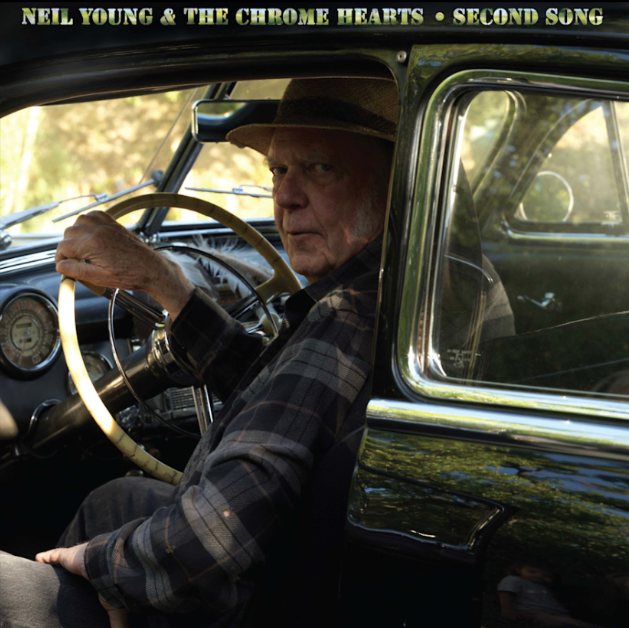
Mellow. Meandering. Mesmerizing. Those three words define what is Neil Young’s umpteenth studio set, this one finding him backed again by the Chrome Hearts, aka the Promise of the Real with Micah Nelson in lieu of brother Lukas and supplemented by the legendary Spooner Oldham, a frequent Neil collaborator who’s perhaps best known for playing organ on a slew of now-classic R&B sides in the 1960s (and cowriting a few, too), when he was part of the Muscle Shoals Rhythm Section. Lyrically, Neil’s in a reflective mood, mostly musing about life and love—to be expected, I suppose, given that he’s 80.
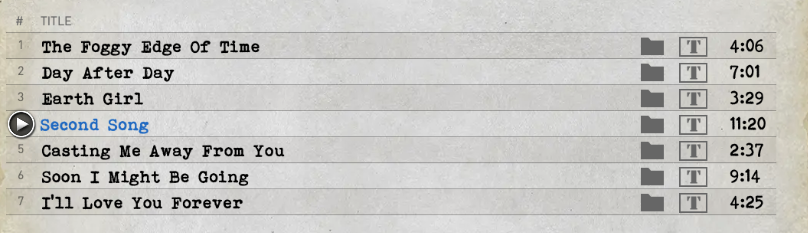
On first listen, the seven-track, 42-minute set plays like a sonic rendition of a winding country road. Where I live, depending which way I turn, suburb blends into urban or rural, with the two-lane roads in the latter bending one way and then the next, running past and through pastures and even dense woods. In a sense, to extend the metaphor, such roads are like life itself: There are curves, straightways and more curves, with speed limits almost always set higher or lower than one expects. The leadoff track, “The Foggy Edge of Time,” touches upon some of that, I think, with anyone who knows the particulars of Neil’s life story being able to read between the lines when he sings, “Out on the foggy edge of time/I was flyin’ low into my prime/I was lookin’ back, not lookin’ good/When I left my old neighborhood behind.” Alcohol, it seems, played a role in that.
In a way, Second Song plays somewhat like an acoustic Broken Arrow, his elegiac (and decidedly electric) farewell to fellow traveler David Briggs, though it’s not quite as mournful. For those too young or old to recall, the initial response to that 1996 album was that it was too sprawling, too ragged, too this, too that. The same’s been said in the few reviews I read of Second Song’s title track. But it, “Day After Day” and “Soon I Might Be Going” stretch out like the aforementioned country roads. In theory, yes, they could be more concise—but eminent domain is a nasty thing best avoided and, too, the roads are surrounded by beauty. There’s something hypnotic about the way they unreel, with Neil’s vocals—as strong as ever—floating in and out and the strum of his acoustic guitar humming like it did in the days of yore, all while the supporting players perfectly color his musings. Along the way, he mixes and matches memories with the present, and bids both adieu and hello to the past and future.
Neil explained to Mojo that his preferred approach to recording is loose: “You don’t want to think about it. You don’t want to have it practiced. The whole idea is to not know what you’re doing.” Or, I’d add, where you’re going. It’s an approach that’s worked well for him through the decades, of course—and for us, his longtime fans. I’d never argue that Second Song is his best album, but my initial listens guarantee that it’ll be much-played in my life for the next good while. It’s his strongest set since Psychedelic Pill.
The album is available for purchase, of course, and can be streamed from everywhere, including from the Neil Young Archives.
The tracks: