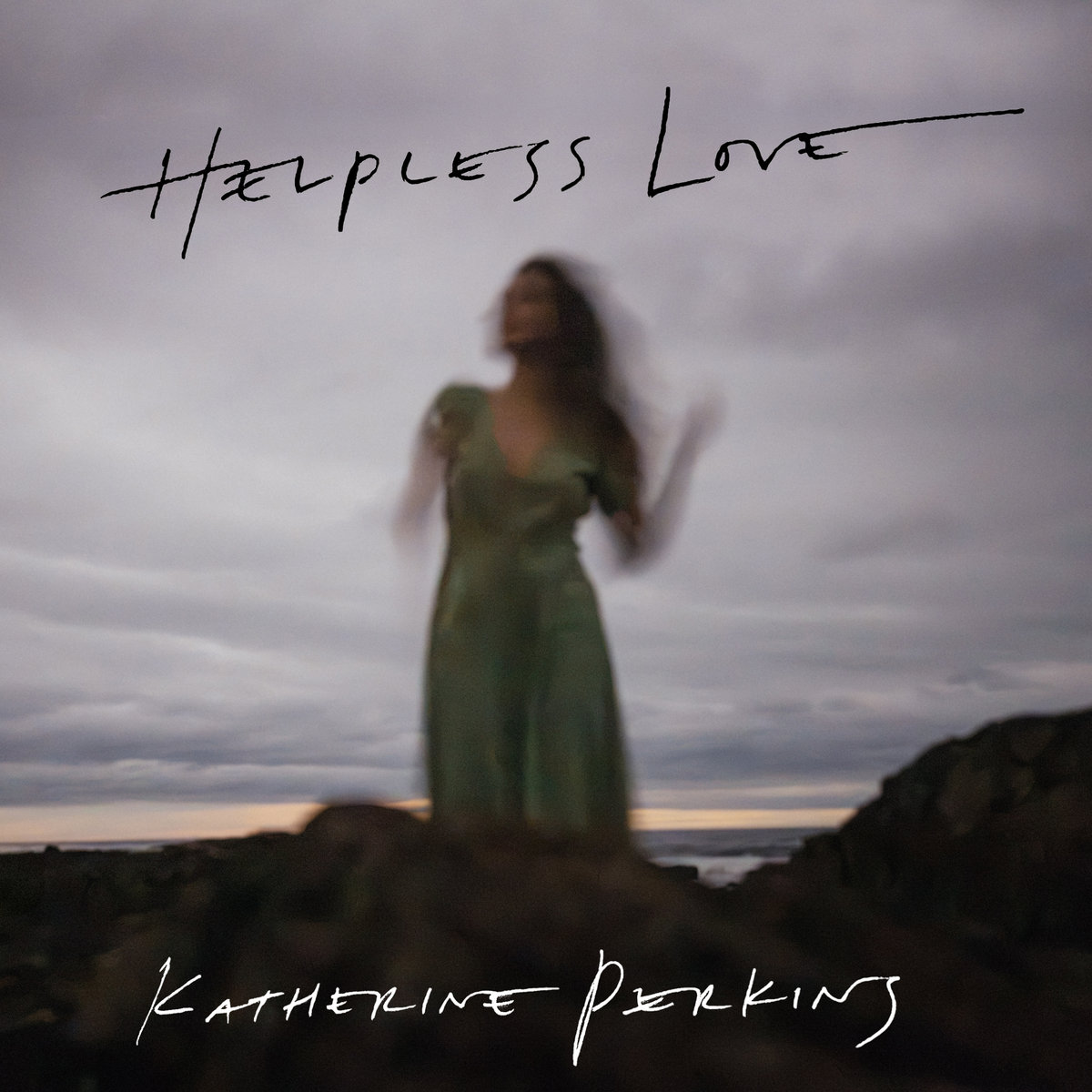
You’ll be forgiven if, upon first listen, you assume Maine-based singer, songwriter and painter Katherine Perkins set up shop 1400 miles southwest in Memphis to record Helpless Love, her sophomore solo set. It features a dusty R&B feel throughout, the kind that leaves you lost in the crackly grooves. (About the only thing missing: the Sweet Inspirations.) In truth, however, it was recorded in Portland and Parsonsfield.
The eight track, 37-minute album casts a wide scope that surveys more than just her own life. In a sense, the songs play like a series of newspaper columns that focus on the realities and banalities of life in the 21st century—often witty, sometimes surreal and/or fantastical, and always from the heart, with the dispatches often pulling double duty: She’s seeking a reason to believe. The press release quotes her as explaining, “[T]here’s a thread running through a lot of these songs of pushing against my own internal currents of despair and futility, finding reasons to keep doing and making and writing things, even when the math doesn’t totally add up.”
It opens with the soulful “Phoenix,” which took flight following a flirtation with witchcraft in the run-up to the 2024 election: “I imagined, not entirely unseriously, that on election day we’d have all of history’s good witches behind us, a steady presence from the spirit realm to help us topple the evil forces of this one. Of course it’s clear to me in retrospect that I wasn’t exactly ‘well’ in that stretch—who among us was? But in the aftermath, having been abandoned by the witches that I’d only recently willed into existence in my mind, I found myself at my piano in a new cold clear reality; ‘Phoenix’ poured itself out into the desolation I was feeling. It was the closest brush I ever had with finding—and losing—religion.”
“Molecules” percolates with a question that’s haunted me this year: whether there’s anything left to say, given that everyone and their brother, mother, cousin and coworkers have become “content creators.” Sometimes, on various social media sites, the observation is made that the musics of the 1960s, ‘70s, ‘80s and ‘90s were somewhat unique, while everything from 2000 on is a sonic blur. (Of course, it’s generally said by oldsters like me—the least likely to hear new sounds.) I think it’s less that than just the tsunami-like nature of pop culture in the 2020s, when more music is released everyday than in the entirety of, to pick a year at random, 1989. (Crazy, right?) The same’s true for those of us who comment on it—where only the brave staked claims on the Wild West that was the old Internet, these days it seems more folks than not have a slick SubStack.
Anyway, enough with the digression—back to Helpless Love: “To the Moon” adds a sci-fi flavor to the proceedings, begging a future Mars colony to not give up on Earth. “The Long Way” leans on something all but the lucky face at some point: disillusionment. (To borrow a line from Bruce Springsteen, “Is a dream a lie if it don’t come true/or is it something worse?”) The moody “Ghost Town,” for its part, revisits an encounter with a possible specter in an ancient Arizona mining town, while the title track—one of my favorites—again embraces that old Memphis sound. “Impossible Things,” meanwhile, explores the inherent magic found in music; it’s a moody tour de force. The album ends with “Swiftly,” a song that should be relatable to anyone like me who’s near or past their sell-by date.
Perkins, it should be noted, produced the set with Fox Schwach and their co-producer Danny Fisher-Lochhead, who handled the horn arrangements. She sings leads, of course, and plays Wurlitzer and piano. The band behind her consists of Rebecca Lasaponaro (Rubblebucket; And the Kids) on drums, Ross Gallagher (Paula Cole; Madeleine Peyroux) on bass, Ryan Blotnick and Tim Semler on guitar, and Schwach on synths. Chris Doyle contributes organ on one track. The horns come courtesy of Fisher-Lochhead (alto sax), Emma Stanley (trumpet, flugelhorn), and Aaron Rourk (bass clarinet).
In short, Helpless Love plays like an album of yore, accented as it is by expansive tracks that never overstay their welcome. It’s moody, retro-flavored, and holds up to repeated plays.

